


The Day After Project Overview of the Education System – Civil Services and Government Policy
עודכן: 13 באוג׳ 2025
Dr. Eyal Bar-Haim
Supervision: Yoni Ben Bassat
Chief editor: Amit Ben-Tzur
Hebrew editing: Daphna Lev
English translation: Dr. Carly Golodets
Design: Adi Ramot
December 2023
The project was written in response to the revealed weaknesses of the government and public services during the October 7 War.
The Israeli education system provides compulsory, funded education for children aged 3 to 16/17 under the Compulsory Education Law. As such, it is one of the largest public budget systems. Nevertheless, it still suffers from chronic under-budgeting, despite the significantly larger budget allocated to it over the last decade (mainly due to collective agreements such as “Ofek Hadash” and “Oz Letmura”). The under-budgeting is expressed by low public expenditure per student, a lack of early childhood (ages 0–3) education frameworks, and most importantly, great inequality in funding and outcomes. Its consequences are mainly manifested through the students’ achievements in comparison to the achievements of students in OECD countries. In this paper, we focus on two aspects of the under-budgeting: the disparity between Israel and the OECD in public expenditure per student and the lack of early childhood (ages 0–3) education frameworks.
The Consequences of Under-budgeting for Students’ Achievements
Israeli students achieve relatively low grades in the international PISA tests (reading, science and mathematics) compared to most OECD countries: their scores are below the OECD average, positioning Israel towards the bottom of the ladder (Figure 1).

Moreover, the proportion of schoolchildren in Israel with particularly weak abilities in reading, science and mathematics is very high compared to the OECD average (Figure 2). In 2022, 21.3% of schoolchildren aged 15 demonstrated significant deficiencies in their reading abilities, rendering them unable to cope with basic texts or with mathematical problems that are not explicit arithmetic exercises.

Finally, in Israel, the disparities in mathematics between schoolchildren from a high socioeconomic background and those from a low socioeconomic background are extreme in comparison to the vast majority of OECD countries (Figure 3).

The Main Causes of the Problems in the Education System
The dissatisfaction with the education system is widespread and covers many issues, including a teacher shortage and poor teacher quality. Another major issue is the inequality in educational opportunities and outcomes based on socioeconomic background. There is also widespread criticism of the quality of the curriculum and its relevance to contemporary society and the labor market. From an organizational perspective, there are concerns regarding the inability of the Ministry of Education to effectively lead and govern the education system, expressed in the outsourcing of key functions such as planning (for example, the research and development division) and supervision (for example, management of the matriculation exams), among others. In the first part of this paper, we described the consequences of under-budgeting for schoolchildren’s achievements. In this part we will focus on two aspects: the disparity between Israel and the OECD in public expenditure per student, and the scarcity of early childhood (ages 0–3) education frameworks.
a. The disparity between Israel and the OECD in public expenditure per student
In recent decades, national expenditure (both public and private) on education in Israel has increased at a significant rate, even considering population and economic growth. Among other things, this increase is expressed by reduced class sizes and increased teachers’ salaries (Blass, 2022). However, our analysis, based on an examination of the disparity in civil expenditure between Israel and the OECD, shows that to close this gap the education system requires an additional sum of approximately 36 billion ILS (Figure 4).
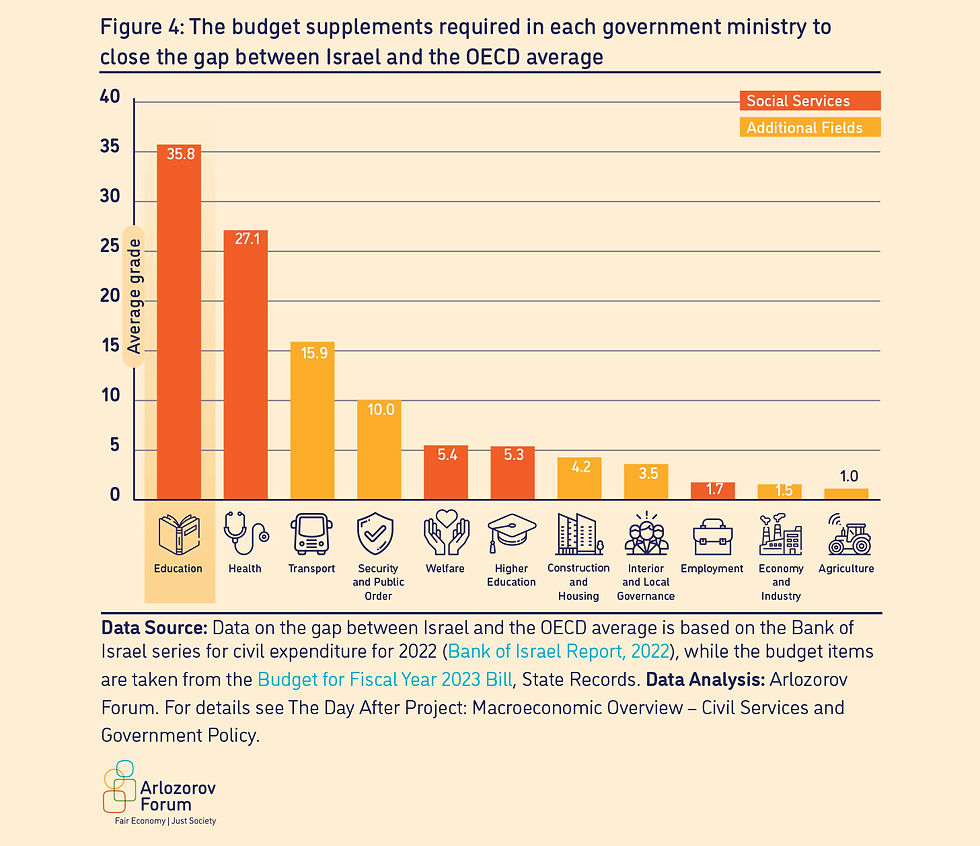
Israel’s population is characterized by a high proportion of children (ages 5–19) in comparison to the OECD average. Therefore, in an international comparison we must assess public expenditure per student on education, alongside total public expenditure on education (Figure 5). After significantly reducing the gap at the beginning of the previous decade following the “Ofek Hadash” and “Oz Letmura” reforms, the gap stabilized, and as of 2020 it stands at approximately 19 billion ILS in comparison to the average and approximately 16 billion ILS in comparison to the median.

What needs to be done?
Gradually increase public expenditure on education by approximately 19 billion ILS, through a multi-year plan, to close the gap with the OECD1.
b. A lack of early childhood education frameworks
Since its regularization under supervision (with respect to safety and labor, but without pedagogical supervision) in 1965, early childhood (ages 0–3) education has been the responsibility of the Ministries of Labor and Welfare, under the assumption that its main purpose is to provide a solution for working mothers. In recent years, the government initiated a process to transfer the supervision to the Ministry of Education; this process was supposed to end in 2023. This change puts early childhood education in a problematic position: it is now a split system, including subsidized, supervized daycares (“recognized daycares”), which provide a solution for 27% of this age group, and private daycares, with minimal supervision, if at all, which provide a solution for 38% of this age group. The remaining toddlers, who comprise 38% of this age group, are not in any framework at all. Furthermore, in line with the rest of the education system, this system suffers even more acutely from a loss of education staff members (over 50% dropout rate of caregivers in the first year) and a lack of suitable training (State Comptroller, 2022).
“Recognized daycares” are the public solution for early childhood; however, as can be seen in Figure 6, there is a great lack of such daycares and their geographic distribution is not even. In Haifa and the nothern region, where the number of children per daycare is the lowest, there are 2.99 children for each existing place in a daycare. In the southern region, for each place in a daycare there are over 4.21 children. In the Jerusalem region, where there are large Arab and ultra-Orthdox populations, there are 7.83 children for each place in a daycare.

What needs to be done?
Public expenditure on daycares must be increased in accordance with the total proportion of daycare users in the population (62% of the age group, the percent that currently uses daycares).
This budget should serve several aims (Blank and Silverman, 2023):
Increase the number of “recognized daycares” – establish subsidized, supervised daycares. We estimate this would require a one-time cost of approximately 14.3 billion ILS2
Improve staff training
Expand eligibility for subsidies
References
Bar-Haim, E., & Feniger, Y. (2022) Tracking and its long-term effects on educational achievements and earnings of high school students in the 1990s. Policy Paper No. 05.2022. Taub Center for Social Policy Research in Israel.
Blank, C., & Silverman, S. (2023). Free early childhood education – challenges and policy alternatives. Taub Center for Social Policy Studies in Israel.Blass, N. (2022). Achievements in Israel’s education system: An overview. State of the Nation Report: Society, Economy and Policy, pp. 103-149. Taub Center for Social Policy Research in Israel.
Israel Central Bureau of Statistics (2023). Statistical Abstract of Israel 2023 – no. 74.
Ministry of Education (2023). Search for a daycare. Parents’ Portal. [Hebrew]
OECD (2023a). Gross domestic product (GDP) (indicator).
OECD (2023b). Public spending on education (indicator).
OECD (2023c). PISA 2022 Results (Volume I): The state of learning and equity in education. PISA, OECD Publishing, Paris.
State Comptroller (2022). Care and education of toddlers in public and private daycares. [Hebrew]

תגובות