


The Old-Age Benefit in Israel
Shira Biblash
May 2025
This paper was written in cooperation with the Histadrut – Seniors Department.
Abstract
The purpose of this paper is to examine the old-age benefit in Israel in comparison to international standards. In Israel, as of the writing of this paper, income during the pension period decreases significantly, which may cause many retirees to continue working. Additionally, since many retirees do not have workplace pensions, the old-age pension is currently a crucial element in maintaining the quality of life during this stage.
In Israel, the old-age benefit is a central pension tool, but it is low compared to international standards. Comparison shows that there is considerable room for improvement in the situation of the elderly population in Israel. As of the writing of this paper, the basic benefit stands at 1,736 ILS, which is only about 13% of the average wage in Israel, compared to OECD countries where the benefits are about 21% on average. The low value of the old-age benefit is the result of a long-term erosion process. In 1954, when the benefit was first introduced, it was set at 25% of the average wage; in the 1980s, it decreased to around 20%; and today (2024), as mentioned, it stands at only 13% of the average wage. Using calculations made in this paper, we show that the budgetary cost of raising the benefit to 20% of the average wage is approximately 15 billion ILS annually. Raising the benefit to this level and indexing it to the Israeli average wage, will prevent its erosion in relation to the income of the working population, thus halting the continued deterioration in purchasing power experienced by the elderly population in Israel for many years.
Executive summary
Introduction
The old-age benefit is the basic guaranteed income for every resident and is distributed universally, meaning it is given to every resident who reaches the age of eligibility.
Due to its universal nature, the old-age benefit reduces inequality and poverty, increases social solidarity, and maintains public support for the benefits.
As of the writing of this paper, the old-age benefit stands at 1,736 ILS per individual, which is about 13% of the Israeli average wage, a figure that is low compared to international standards.
The insurance structure of the old-age benefit
The primary funding for the old-age benefit comes mostly separately from the state budget, and the benefit functions like insurance: residents pay social security contribution (SSC) during their lives, and when they reach retirement age, they begin to receive the payments.
The insurance structure serves as a cornerstone for public trust in the existence of the benefit, thus strengthening the justification for its existence, the public's willingness to pay for it, and their sense of security that their needs will be met at old age.
The importance of the old-age benefit
The old-age benefit is progressive, and as such, it plays a role in reducing inequality. While workplace pensions maintain inequality among the elderly, the old-age benefit reduces it.
The replacement rate (income during retirement in relation to pre-retirement income) in Israel is significantly low compared to international standards. In 2022, it stood at 28% for those with high income and 57% for those with low income, while the OECD average was 52.8% and 74.7%, respectively. For illustration, the average wage in 2022 was 13,091 ILS according to OECD data. The Israeli replacement rate brings the benefit income to 3,730 ILS for low-income individuals. If we had the OECD replacement rate, their income would be 4,889 ILS.
The percentage of elderly residents continuing to work in Israel is remarkably high compared to international standards. This may indicate, among other things, the need to continue working even after retirement age due to relatively low income after retirement.
There is a negative correlation between the poverty rate among people aged 65+ and the old-age benefit as a percentage of the average wage. Thus, the benefit helps lift families above the poverty line.
Options for indexing the old-age benefit
There are three main methods for updating the level of the old-age benefit to prevent its erosion:
Indexing to the Consumer Price Index (CPI), which maintains constant purchasing power;
Indexing to the average wage, which maintains purchasing power relative to the working population (relative purchasing power);
Combined indexing to both wages and the CPI.
Over time, the cost of indexing to the CPI is lower, but during periods of economic growth, it erodes the income of elderly residents relative to the rest of the population.
The cost of indexing to the average wage is higher, but it distributes the benefits of economic growth more equitably between pensioners and workers.
Different countries update the benefits at varying frequencies. The most common update frequency is annually.
The old-age benefit in Israel
The benefit in Israel has significantly eroded relative to the average wage.
In 1975, the old-age benefit was indexed to the average wage, in 2003 it was frozen, and in 2006 it was indexed to the Consumer Price Index, an indexing that continues to the present day (2024).
From the 1980s to the present, the benefit has eroded significantly relative to the average wage, and as of the writing of this paper, it stands at 1,736 ILS per month (about 13% of the average wage).
What the value of the old-age benefits in Israel could have been with different indexing methods
If the benefit had been indexed to the average wage since 1986, it would now stand at 2,446 ILS per month (about 19% of the average wage).
The cost of increasing the benefit to 15%, 20%, and 25% of the average wage, would be an additional 3, 15, and 27 billion ILS, respectively (in 2023 terms).
Had the benefit not eroded since 1986, it would be higher today by about 7,000 ILS annually. The additional cost would be about 12 billion ILS in 2023.
Summary
The old-age benefit is universal, which makes it less controversial and increases public trust in the benefit compared to other benefits. The old-age benefit contributes to maintaining the welfare state, protecting and supporting its citizens, reducing gaps in society, and lifting families above the poverty line.
The National Insurance budget funds many important benefits. This paper does not compare the various benefits and their importance, and therefore it does not recommend prioritizing the old-age benefit over other benefits.
We see great importance in indexing the old-age benefit to the average wage. As of the writing of this paper, the old-age benefit is very low and is indexed to the CPI. This indexing may preserve the benefit‘s purchasing power and prevent erosion relative to the CPI, but it also creates continued erosion of the benefit’s value compared to the working population. Indexing the old-age benefit to the average wage will stop this erosion.
1. About the Old-Age Benefit and Its Importance
What is the Old-Age Benefit?
Ensuring a high quality of life in old age is important for every person, whether because they have an elderly relative in their life or because they themselves will eventually reach an old age. Ensuring an adequate standard of living at this stage is based on the economic foundation provided by pensions, together with the social services provided by the state. The pension consists of three tiers: Public Tier – Basic benefits given universally or based on certain conditions. In Israel, this tier is the old age benefit (the amount received by anyone who reaches retirement age) and the target benefit or Income Supplement, which is the amount received by anyone who reaches retirement age and whose income does not exceed a certain threshold; Workplace Tier – Commonly known as "pension," a benefit given from retirement age based on the contributions of both the worker and the employer to a designated fund; and Private Tier – Private investments intended for use in retirement and beyond (OECD, 2023 a) (Figure 1). It is important to remember that the standard of living in old age is influenced by all of the pension tiers, and a broad perspective on all of them is needed when making decisions or implementing policies. However, for the purpose of this review, we are focusing only on the old-age benefit in order to provide a comprehensive overview of it.

As mentioned, the old-age benefit is part of the public tier and is the most basic pension protection, as it is distributed universally based solely on residency. This means it is guaranteed to all residents.[1] The benefit is progressive because all citizens receive the same fixed amount. For citizens with low income, this amount constitutes a larger portion of their income, which helps reduce income disparities. It is important to distinguish between the old-age benefit and the income supplement, which is also part of the public tier, but is not provided to all residents. It is conditional on meeting criteria of need (low income), and therefore it is not distributed to all elderly citizens. Another difference between the two benefits is their funding. The income supplement is entirely funded by the state budget, while the funding for the old-age benefit primarily comes from the contributions of employers and employees to the NII.[2] In other words, the old-age benefit has an insurance component, and is not merely a targeting tool.
The Universality of the Old-Age Benefit
The old-age benefit is universal, meaning it is provided to all residents without income tests. Although we are not concerned with comparing different benefits, the universality of the old-age benefit constitutes a significant advantage compared to many other benefits.
The comparative discussion between a selective benefit, which is distributed to a population that meets certain income criteria (in the case of pensioners, the income supplement), and a universal benefit, which is distributed to all residents (in the case of pensioners, the old-age benefit), is a subject of debate in academic literature, focusing on the effectiveness of these approaches and the extent to which they reduce poverty and inequality. This discussion is part of an extensive body of literature that addresses the comparison between universal welfare policies and selective welfare policies.
In terms of effectiveness, the literature does not show a clear advantage for one approach over the other. The most significant advantage of the selective approach is its low cost: when funds are targeted more specifically, costs decrease. However, universality also has several significant advantages. Since there is no need for income testing, there are no people who "fall through the cracks" and fail to receive what they are entitled to (typically the most vulnerable populations who struggle to access their rights). (Atherton and Webb, 2024; CESCR, 2008). Additionally, a larger portion of the budget allocated to the benefit can reach eligible individuals, as there are fewer operational costs involved in determining eligibility (since everyone is eligible). Another advantage is that universality generates relatively broad political support for programs, as all population groups benefit from them. (Gelbach and Pritchett, 2002). Moreover, the universal approach fosters a sense of solidarity and reciprocity within the population (Bergmark, 2001; Eschweiler et al., 2019; Frederiksen, 2018). In contrast, the selective approach creates an incentive to remain with low income, as earning above a certain threshold leads to the loss of support. (De Donder and Hindriks, 1998)
In terms of reducing poverty and inequality, there is a large body of literature showing that universal programs are more effective at reducing inequality and poverty compared to selective programs. (McKnight, 2015; Jacques and Noël, 2018; Kidd, 2016; Korpi and Palme, 1998; De Donder and Hindriks, 1998; Gelbach and Pritchett, 2002; Marx, 2013; Salanauskaite and Verbist, 2013)
Thus, universality is an important feature of welfare policy in general, and of the benefits mechanism in particular. Although there is debate among researchers about the level of effectiveness of universal policy compared to selective policy, many experts support the claim that the universal approach is more effective at reducing poverty and inequality, two goals of paramount importance that lie within the responsibility of the state.
The Old-Age Benefit as Insurance
The question of funding old-age benefits has been raised in Israel many times over the years (Doron, 1998). The primary goal of the old-age benefit was to provide insurance, into which every citizen contributes a portion of their salary (payments to the NII) throughout their life, so that if and when they reach old age, they will receive a payment that guarantees them some income. In the context of the old-age benefit, this means that when a citizen reaches retirement age, after which they no longer work, they will be guaranteed some income. In other words, receiving the benefit depends solely on reaching retirement age, and it is mainly funded by the national insurance contributions paid by residents for this purpose, rather than by other taxes (state budget). This is the “insurance nature” of the old-age benefit (Koreh, 2019).
The issue of the funding of the NII is complex, and we do not delve into it deeply in this document.[3] However, we will mention here a few central reasons, as noted by Koreh and Mandelkern, for the importance of a funding system that is almost entirely independent of the state budget in the insurance field, and that, as a result, also applies to old-age benefits (Koreh and Mandelkern, 2023; 2019).
First, the insurance nature of the benefits gives citizens a sense of security that the state will take care of them in old age. This sense of security is crucial for them to feel confident both during their working life and in retirement.
Second, in Israel, workplace pension savings are invested in the stock market. While this increases the monthly pension benefit in the long term, it comes at the cost of increasing risk. In other words, if the market falls, the pension may be affected, especially if the downturn occurs close to retirement age or during retirement itself. To mitigate this risk, there are different investment tracks for different age groups. However, this solution does not cover all the risk. In such cases, citizens must rely on the state to provide them with economic security. The state can provide this protection in several ways, and one of them is through old-age benefits. Thus, granting the benefit universally to everyone who reaches retirement age reduces the residents' concerns in the face of extreme situations.
The final point concerns trust issues. The state budget changes from year to year and is heavily influenced by the political fluctuations of the government. Separating the funding of the old-age benefit from the state budget may strengthen public trust that there will be no significant changes over the years, and that the insurance contributions they pay will not be diverted to other expenses. Additionally, the insurance nature and the universality of the benefit generate public support for its funding. When residents know that the money they pay as insurance contributions to the NII will be partially returned to them, at least in old age, their opposition to paying decreases, and the benefit gains more public legitimacy. For example, Koreh and Mandelkern argue that the insurance structure, detached from other government expenses, serves as a cornerstone of public trust in the existence of the benefit, thus strengthening the justification for its existence, the public’s willingness to pay for it, and their sense of security that their needs will be met in old age. (Koreh and Mandelkern, 2023)
Therefore, the insurance nature and universality of the old-age benefit are significant parts of its advantages, especially compared to other, cheaper solutions for a dignified life for the elderly population, and particularly when compared to the income supplement, which is funded by the state budget and provided based on need.
2. Old-Age Benefits in Israel
Income During Retirement Decreases Significantly
In comparison to international standards, retirement income in Israel is significantly lower than pre-retirement wages. One of the key indicators used to compare the situation of the elderly population across different countries is the replacement rate: the ratio between income during retirement and the salary the retiree received prior to retirement.[4] The replacement rate indicates how well the retiree's standard of living is maintained compared to their working years. Figures 2 and 3 show the net replacement rate (after taxes and transfers)[5] for retirees with low income (half the average wage in the country) (Figure 2) and for retirees with high income (twice the average wage in the country) (Figure 3) in OECD countries and the comparison countries (countries similar to Israel in size and potential, and therefore often used for comparisons in various policy areas).[6]


From the figures, it is evident that Israel's replacement rate is lower than that of other countries, across both income levels. In other words, income during retirement drops significantly for the elderly population as a whole. For those with low income, the replacement rate is about 16 percentage points (1.3 times) lower than the OECD average, and about 29 percentage points (1.5 times) lower than in the comparison countries (Figure 2). Additionally, those earning half the average wage experience a significant drop in income, to about 57% of the salary they previously earned, which is about 28% of the average wage, or roughly 3,730 ILS, according to OECD data.[7] Hypothetically, if Israel's replacement rate were similar to the OECD average (74.7%), low-income retirees would be entitled to an income of 4,889 ILS per month, which would be significantly higher than their current income. For comparison, according to the NII, the poverty line in 2022 was 3,845 ILS per-month[8] (Kasir, Pines, and Flam, 2023). This means that low-income retirees, earning half the average wage or less, may fall below the poverty line during retirement.[9]
The issue of income during retirement in Israel is not limited to low-income earners. The decline in income for high-income earners is also significant. As shown in Figure 3, during retirement, the income of high earners reaches only about 27% of the salary they were accustomed to, or in other words, about 54% of the average wage. Here too, Israel is below other countries: about 25 percentage points lower than OECD countries (almost twice as low), and about 41 percentage points lower than benchmark countries (2.5 times). It is important to emphasize that this population experiences a significant reduction in their standard of living during a period of life when there should be more welfare and less financial worry. This data highlights the importance of increasing income during retirement, beyond just the income supplement allowance (which focuses solely on vulnerable population), and raises the importance of the universal old-age benefit. It is worth noting that many retirees currently do not have workplace pensions, but this is expected to change in a few decades, once enough time has passed since the introduction of mandatory workplace pensions in 2008. When we reach a situation where all retirees are covered by a full workplace pension, it will be useful to reassess the data. However, until then, the importance of the old-age benefit remains unchanged.
Employment Rate Among Those Aged 65 and Over in Israel is Very High
Figure 4 presents the employment rate among those aged 65 and over, as well as the replacement rate for individuals earning the average wage, across different OECD countries. First, it can be observed that in Israel, the employment rate among this age group is higher than in other countries, about 5 percentage points above the OECD average and twice as high as in the comparison countries. Second, and similarly to the findings presented in Figures 2 and 3 for low and high-income earners, the income of individuals earning the average wage decreases significantly during retirement in comparison to other countries. The combination of these indicators suggests a correlation between countries where the elderly population chooses to continue working at an older age and countries with a low replacement rate. It is likely that several factors contribute to this phenomenon, but the concern is that this data may indicate that despite reaching an advanced age, individuals are unable to afford to stop working because the income from the three pension tiers is insufficient.

The Old-Age Pension in Israel is Very Low Compared to International Standards
In general, when the government sets policy, its broad goal is to ensure the quality of life for its residents. In the case of old-age benefits, this refers to the quality of life for elderly residents, and therefore it is important to understand the relationship between the old-age benefits and various quality of life indicators. One way to assess the quality of life provided by the benefits is to look at the benefits as a percentage of the average wage. This data indicates the purchasing power of the benefits recipient relative to that of an average person, and allows for comparisons both over time and between different countries.[10]
Not all countries in the world implement a policy of universal old-age benefits. The pension system is complex, and there are many alternatives. For example, some countries have pensions where the amount received upon retirement is predetermined and not dependent on the stock market or contributions over the years (Defined Benefits, DB). Examples of such countries include Austria, Belgium, and Canada, where the pension paid from the employment layer is predefined (OECD, 2023a). In these countries, there is not necessarily a need for a universal old-age benefit.
Figure 5 presents the level of the old-age benefit as a percentage of the average wage in countries where universal old-age benefits are practiced. Currently, Israel’s universal old-age benefit is lower than that of other countries. According to the OECD, in 2022, the Israeli benefit stood at about 10.2%[11] of the average wage, compared to 20.9% of the average wage in OECD countries. Additionally, when comparing to two of the comparison countries that implement universal benefits policies (Denmark and the Netherlands),[12] it is evident that their benefits make up an average of 23% of the average wage, more than twice the benefits in Israel. It is important to note that in most countries without a universal benefit, there is an income-based benefit, and many countries also have public pensions or other pension tools that serve as a substitute (OECD, 2023a). It is also important to highlight that this comparison may be problematic, as in some countries, the old-age benefit is a central pension tool, whereas in others, it is not. In countries where the benefit is not the main tool, the benefit’s level may be less significant, but in countries where the benefit is a central pension tool, the level of the benefits is a crucial factor for retirees' quality of life.

In 2022, the percentage of individuals receiving workplace-based pensions in Israel stood at only 42% (meaning 58% of retirees in Israel did not receive a pension from the workplace tier).[13] Additionally, according to the Central Bureau of Statistics’ survey on household expenditure and income, the old-age benefit accounted for 61% of the total income of retirees receiving this benefit in 2022.[14] Thus, in Israel, the old-age benefit serves as a primary source of income for most retirees, meaning it is a central pension tool. Despite this, the old-age benefit is still very low by global standards. Without a detailed analysis of the pension systems in other countries, it is difficult to precisely determine Israel’s relative position. However, if in other countries the old-age benefits are not a central component of retirees' income, one might expect that in Israel, where the benefit is a central component, the level would be higher in comparison. However, in practice, Israel is ranked at the bottom in terms of the benefit’s level. In other words, regardless of the old-age benefits of other countries, the old-age benefit in Israel remains low. It is worth noting that although Israel introduced mandatory workplace pensions in 2008, meaning that the old-age benefit is theoretically expected to lose its central role, it will take a long time before all retirees will have a fully accumulated workplace pension from their years of work. When this process is realized, it will be possible to reassess the importance of the old-age benefit. However, for now, the old-age pension remains a significant and central pension tool for most retirees.
The Old-Age Benefit is Progressive and Contributes to Reducing Inequality
In addition to maintaining the standard of living, the old-age benefit and the target benefit (income supplement benefit), which are progressive, also contribute to reducing inequality. Since
the old-age benefit is distributed as an equal amount to all eligible recipients, they increase the income of low-income individuals at a higher rate, thus reducing inequality and contributing to an overall improvement in the standard of living (Wilkinson, Pickett, and De Vogli, 2010). Furthermore, the old-age benefits improve the situation of low-income individuals more than that of high-income individuals, bringing them closer to the standard of living of their peers—elderly citizens from a higher economic status. The income supplement benefits also reduce disparities and are less costly because only those in need receive them.
As part of the research work of Adi Brender (2010), Brender conducted a comprehensive analysis of various pension plans by defining ten types of citizens and analyzing the different impacts of pension policies in Israel on these types. The article was published in 2010, so the analysis does not include the changes that occurred following the expansion orders signed later (in 2011 and 2016). Brender found that universal benefits programs, along with target benefits, serve as progressive tools, enabling low-income individuals to increase their income during retirement compared to high-income individuals (Brender, 2010).
A discussion on the importance of the progressivity of the benefit also appears in Orly Forman's (2024) article, where she demonstrates the effect of the old-age benefit on the distribution of pension income according to quintiles. Figures 6 and 7, taken from Forman's work, show that the old-age benefit significantly reduces inequality between the quintiles beyond what occupational pensions can achieve. In Figure 6, we can see that while workplace pensions bring the different quintiles to a similar replacement rate, the old-age benefit brings the lower quintiles to a much higher replacement rate. The increase between the 1st and 5th quintiles is more than double. It is important to remember that this does not mean that the absolute income is equal. The income of the top quintile is likely still higher, but the lower quintiles maintain a standard of living closer to what they had during their working years.

Figure 7 presents the different components of the replacement rate across the quintiles. It shows that the old-age benefits component is significant mainly for the lower quintiles, while occupational pensions are more significant for the upper quintiles. The old-age benefits component in the bottom quintile is almost four times the component in the top quintile. This highlights the great importance of the old-age benefits for poorer and more vulnerable populations, populations for whom the state has a responsibility to ensure their welfare.

Increasing the Old-Age Benefits Will Lead to a Decrease in Israel’s Poverty Rate
Another significant indicator of the quality of life for pension recipients is the poverty rate among elderly citizens. According to data from the NII, in 2021, the poverty rate among elderly citizens, after transfers and taxes, was approximately 16.7% (meaning nearly 1 in 6 were below the poverty line). Figure 8 shows the correlation between the poverty rate and the old-age benefits as a percentage of the average wage. From the figure, it is evident that there is a negative correlation between the poverty rate and the level of the benefit. In other words, a relatively high level of the old-age benefit compared to the average wage may improve the situation of elderly citizens. Indeed, according to the poverty report, already today, the old-age benefit, along with the survivors’ benefits, significantly reduces the poverty rate. As of 2022, the reduction in poverty incidence among families was 24%, meaning the poverty rate after benefit payments dropped by 24% compared to the poverty rate before benefit payments (Kliner, Pines, and Flam, 2023).

In conclusion, the old-age benefit is crucial to the standard of living for elderly residents. It is progressive, and thus reduces economic disparities and leads to a lower poverty rate among elderly citizens (Kliner, Pines, and Flam, 2023). However, as compared to other countries, the situation of Israel’s elderly population requires improvement: the replacement rate is low across all income levels; the old-age benefits are low compared to OECD countries, despite being a central pension tool; and the employment rate among elderly people in Israel is high.
3. Options for Updating the Old-Age Benefit
Since the mid-2000s, developed countries have begun emphasizing the need to balance the desire to implement sufficiently high old-age benefits to maintain a high standard of living with the need for fiscal restraint, meaning keeping expenses low in order to avoid overburdening the state budget and increasing the tax burden (Hohnerlein, 2019). The challenge of maintaining a high standard of living through old-age benefits is intensified under conditions of inflation (price increases) and wage growth, where the benefit may erode. In other words, to maintain the purchasing power of the benefit, it must be regularly updated.
To address this challenge, it is common to link (to index) benefits to a specific index, so that the benefits increase at the same rate as the index to which they are linked. This prevents the erosion of the benefits relative to that index. The most common indexations are to the Consumer Price Index (CPI) or to the average wage. There are also other, less common forms of indexation, such as indexing to the minimum wage, to a CPI designed for the elderly population, to cost-of-living indices, or to GDP. Some countries combine multiple indexations, usually by averaging several indices. The most common combination is between the CPI and the average wage (OECD, 2023a).
Indexing the benefit is particularly important for low-income earners. First, indexation helps maintain the standard of living provided by the benefit, and its universality ensures the preservation of both the benefit and its level, which is important for social solidarity, public support for the benefit, and more. Second, indexing the benefit can help keep some low-income individuals above the poverty line. Third, the benefit is progressive, and therefore contributes to reducing economic disparities. That is, when all citizens receive the same benefit amount, individuals with lower incomes experience a greater increase in their income. These characteristics erode in the absence of indexation.
Given the tension between fiscal restraint and the policy of reducing disparities and ensuring quality of life, it seems that in recent years, countries tend to prioritize fiscal restraint, which is why more and more indexations are tied to indices that increase at a relatively low rate (primarily the Consumer Price Index) (Hohnerlein, 2019). However, contrary to the global trend, there are countries that are moving in the opposite direction and prioritizing a higher standard of living for retirees, and therefore index their pension components primarily to wage indices, such as the average wage (e.g. Denmark). Figure 9 presents the different indexations of the public tier pension (in Israel, old-age benefit and target benefit) in various OECD countries.[15]

Price Indexations
Out of the 38 OECD countries that implement a public pension tier, 19 countries index the benefits to some price index, most commonly the Consumer Price Index (CPI). The goal of this indexation is to maintain the purchasing power of the benefits relative to a fixed basket of goods and services. This form of indexation is considered a fiscally conservative approach, meaning it is inexpensive for the state, as prices generally rise at a slower pace than wages. Therefore, a benefit indexed to prices increases more slowly than one indexed to wages, and the state's expenditure on the benefit is lower. Most countries that adopt this policy do so in order to control the cost burden of old-age benefits (OECD, 2023a).
The problem with this type of indexation is that while it maintains the purchasing power of the benefit relative to a fixed basket of goods and services, and prevents erosion relative to the price index, it does not prevent erosion relative to the average wage. Thus, the benefit erodes relative to the purchasing power of the rest of the population. This is because average wages typically rise faster than prices. In other words, while the average worker can buy more with their salary, the benefit recipient can only purchase the same basket. This means their relative purchasing power erodes (Hohnerlein, 2019).
Some countries index the benefit to a special consumer price index developed for the elderly population, such as Belgium and France (Hohnerlein, 2019). In Israel, such an idea was also raised by the Israel Democracy Institute (Sheshinski et al., 2022). The rationale for this index is that the elderly population consumes a different basket, whose price increases at a higher rate than the basket for the general population. Therefore, a separate index should be created for them, and the benefits should be indexed to it. According to Sheshinski et al., had the benefits been indexed to this elderly CPI since 2013, they would have been about 500 ILS higher in 2020. However, their comparison was made only between the CPI and the elderly CPI. Other options, particularly indexing to the average wage, were not considered.
There are additional difficulties with this proposal. First, there is currently no such index in Israel, so it would be necessary to develop one. Second, while there are countries in the world that use this form of indexation, they do so for the opposite reason, namely to reduce the rate of increase of the benefits. For example, in France and Belgium, the index was developed without tobacco, alcohol, and fuel products. This change was made to erode the benefits, not to reflect the unique consumption patterns of the elderly population (Hohnerlein, 2019). In other words, developing such an index could lead to different outcomes depending on how the index is defined. As long as there is no professional consensus on the components of the index, the development of the index and linking the benefits to it could become another decision point, where the benefit level could be manipulated according to political desires and economic views, in a non-transparent manner, by using different definitions of the basket.[16]
Wage Indexations
Five OECD countries that implement a public pension tier index the benefits to a wage index (OECD, 2023a). The goal of indexing to the average wage is to maintain the purchasing power of the benefits relative to the average wage. This form of indexation allows retirees to benefit from the economic growth, and to a large extent, to maintain their standard of living compared to the rest of the population. For the same reason, this type of indexation is considered more expensive for the state, as the benefits increase at a faster rate than when they are indexed to the CPI (Hohnerlein, 2019).
In general, pension benefits replace wages at the age when individuals no longer receive a salary. Therefore, it makes sense to index pension tools, particularly old-age benefits, to the average wage. However, there are at least two reasons for the growing global trend toward fiscal restraint on this matter. First, population aging leads to a rapid increase in the number of benefit recipients compared to the slower growth of the workforce, which makes it harder to fund such benefits. Second, the slowdown in growth in developed countries makes it more difficult to fund an increase in the standard of living for the entire population, particularly for non-working populations like retirees (Hohnerlein, 2019).
Both population aging and the growth slowdown are relevant to Israel as well, but this relevance is lower for two main reasons. First, in the last two decades, Israel's growth has been higher than in other developed countries.[17] Second, the country's population is younger than the OECD average and is expected to remain younger than average (OECD, 2023b). Nevertheless, while globally the approach of indexing old-age benefits to prices is relatively new (Hohnerlein, 2019), Israel stopped indexing old-age benefits to the average wage in 2003 (National Insurance Law - Hebrew) in order to reduce budgetary expenses (NII, 2003). Additionally, the global shift towards indexation to the CPI has not been without public criticism. The main criticism is that the change in indexation eroded benefits relative to the working population and harmed the elderly, especially the more vulnerable elderly population (OECD, 2023a; Hohnerlein, 2019).
Moreover, from 1986 to 2024 (the years for which we have data), wages in Israel have risen faster than prices. This means that the purchasing power of the average Israeli worker has increased, creating a gap between the purchasing power of the old-age benefits. While workers benefit from the high growth in real wages, retirees do not enjoy the fruits of this growth.
A possible way to address the high cost of indexation to wages is through the funding method. In Israel, the old-age benefits are funded by employee and employer contributions to the NII. These payments depend on wage levels (they are set as a percentage of salary). Therefore, there seems to be financial potential in Israel for indexing the benefits to wages, despite the higher cost, because as wages increase, so do contributions to National Insurance.[18] However, in this paper, we are only considering the old-age benefits. There are many other benefits funded by National Insurance contributions, and this paper does not assess their situation or importance relative to the old-age benefits.
In 2024 Israel, as part of fiscal reduction policies, most benefits are indexed to the CPI. An exception to this is the disability benefits, which, following protests by disabled persons and their political activities, were indexed to the average wage in 2022. Disability benefits were introduced in 1974 under the National Insurance Law and were initially indexed to the average wage. In 2002, as part of the extensive reforms implemented by the MOF (Ministry of Finance) during those years, the disability benefits, along with old-age benefits and other benefits, were indexed to the CPI. In 2022, the indexing of disability benefits was returned to the average wage. This change did not come at the expense of other benefits.
Combined Indexation
13 OECD countries that implement a public pension tier index the benefits to both a wage index and a price index (OECD, 2023a). Some of these countries use a weighted average (for example, Norway indexes 50% to the price index and 50% to the wage index), while others use different methods (for example, the UK chooses the higher of the two) (OECD, 2023a). This method creates a balance between the types of indexation and has several significant advantages.
First, although indexation to the CPI is considered fiscally conservative, while indexation to wages is seen as prioritizing the standard of living for retirees, during times of crisis, these goals can be reversed. For example, in 2022, when inflation in Europe was very high, in countries that indexed benefits to wages, the benefits eroded and reached a point where purchasing power decreased significantly. In contrast, in countries that indexed the benefits to a price index, purchasing power was maintained, but the costs to the state were higher (OECD, 2023a). This situation led countries to deviate from established rules and create adjustments based on the country's needs and ideological choices. For example, in Latvia and Poland, benefits were updated even though the scheduled time under the law had not yet arrived (OECD, 2023a). Thus, in extreme cases, combined indexation can serve as a balancing factor for changes in the benefits. During periods of significant increases in one of the indices, the rising index will keep the benefit high, while the other index will moderate the benefit increase, thereby also moderating the increase in the required budget for funding the benefits. For example, during the high inflation of 2022, there was a significant increase in prices. In countries that implemented combined indexation, the portion indexed to the prices pulled the benefit upwards, while the portion indexed to the average wage helped maintain fiscal restraint.
Second, combined indexation can serve as a compromise in the tension between maintaining a standard of living in old age and fiscal restraint. The benefit will allow, even if not fully, some of the economic growth to reach elderly citizens, while also maintaining fiscal discipline.
Combined indexation also has disadvantages. First, being a compromise is in itself a disadvantage, it means that benefit recipients only enjoy part of the growth, not all of it. Second, this indexation is more expensive than indexation to a price index. Third, it may suffer from more frequent structural changes. That is, it is likely that, from a political standpoint, it is easier to alter components within the indexation system (the weight given to each type of index) than to change the indexation method itself. Therefore, in a certain scenario, the indexation may start generously (for example, by giving more weight to wage indexation), and over time, through small changes in percentages, the indexation may shift to being primarily indexed to a price index.
In extreme cases, such as during periods of high inflation when significant changes occur in prices and wages, the purchasing power of the entire population changes significantly. Naturally, during such a time, the benefits will also change according to the actual indexation, and thus the purchasing power of the elderly population and the cost of old-age benefits will also change. In such a case, it can be argued that it is not appropriate to deal with changes in the benefits through another adjustment, such as combined indexation, but rather by addressing the underlying economic change itself. In other words, the broader solution is to address the changes in wages and prices that caused the large shifts in the first place (Ben Basat, 2022; Lan, 2023).
Frequency of Indexation
Another consideration is the frequency of updating the benefits. This refers to the pre-defined interval of time until the benefits are updated. For example, in Israel, the old-age benefits are updated once a year, in January (National Insurance Law- Hebrew). Therefore, at the start of each new year, the index to which the benefits are indexed (currently the CPI in Israel) is reviewed, and the benefits are increased by the same rate. The question arises as to what is the correct update frequency for Israel.
The most common update frequency in OECD countries is once a year, but different update frequencies can also be seen worldwide. The highest frequency is once a month (the frequency at which Chile updates its workplace pension tier), and the lowest is once every three years (the frequency at which Poland updates its targeted benefits) (OECD, 2023a).
A potential disadvantage of updating the old-age benefits at a high frequency is that the annual cost increases[19] (see detailed breakdown in Chapter 5: Budgetary Estimate for Permanent Change in Indexation Method). Another argument against a high update frequency concerns the nature of indexation. Since the pension is meant to replace wages during a time when the individual is no longer working, and wages are not updated monthly, it is reasonable that the benefits would not be updated monthly either.
The advantage of frequent updates is that the erosion of the benefits between updates is reduced, but in the next two chapters of this paper, we analyse the difference in update frequencies for Israel, and we do not see significant differences between the methods in recent years. Therefore, as long as there are no extreme situations, such as high inflation in a short period or drastic changes in labor market conditions, the erosion between updates is not large. However, even in situations where there is extreme erosion in a short time, there is a solution.
Some countries adopt an update threshold policy. This means updating the benefits whenever the index to which they are indexed undergoes a change greater than a certain percentage. For example, in Belgium, the pension is updated when the price index increases by more than 2%, and as long as fluctuations are below this threshold, it is not updated. In this case, frequent updates may also occur, for instance, if there is a 2% increase within a week, the benefits would be updated for that week. Like the type of indexation, some countries implement both methods. For example, in Luxembourg, there is a fixed annual update, but if the index exceeds a 2.5 percentage point threshold within the period, an additional update is made (OECD, 2023c).
4. Erosion of the Old-Age Benefits in Israel
Ongoing Erosion Since 1975
The decision to pay old-age benefits in Israel was made in 1954 as part of the National Insurance Law, and the benefit was set at a figure equal to 25% of the average wage. However, the law did not establish a mechanism for updating the benefit, leading to its erosion, and by 1965 it had dropped to about 10% of the average wage. As a result of this erosion, the issue was brought to the agenda, and after lengthy discussions between the MOF, the NII, and occasionally the Histadrut (the largest labor union in Israel), it was decided in 1965 to add an income supplement benefit. Since the income supplement benefit is means-tested and not universally distributed to all National Insurance contributors, it is not an insurance benefit but rather a form of welfare benefit. Given that mixing the funding of benefits could harm public trust in those paying the insurance contributions, and thus in the NII itself (as explained in Chapter 1), it was decided to separate the funding of the income supplement benefit from that of the old-age benefits and fund it through the state budget (Doron, 1998; Koreh, 2019).
In 1975, during the first government of Yitzhak Rabin, the old-age benefit was first linked to the average wage in order to preserve its value relative to the average purchasing power in the country (Doron, 1998; Geva and Moav, 1981). Figure 10 shows the benefit level relative to the average wage.[20] As mentioned, the benefit was set in 1954 at 25% of the average wage, and since then, a continuous erosion of its purchasing power has occurred relative to the working population. In the 1980s, the benefit stood at about 19% of the average wage, and although it was indexed to the average wage, we still see erosion relative to it in these years.[21] In 2003, it was decided to freeze the benefit and simultaneously reduce it by 4% in a one-time reduction. In 2006, the freeze was lifted, and the benefit was indexed to the CPI, an indexation that continues to this day (2025) (National Insurance Law - Hebrew). The erosion of the benefit continued until 2009, when it reached 15%. The government's decision in 2006 to increase the benefit to 17.5% of the average wage, and then to 19% of the average wage in two stages (Zerachia, 2006), did indeed raise the benefit and stabilize it at about 17% for several years. However, since 2012, we have seen a significant decrease, and by the end of 2023, the benefit stood at less than 13% of the Israeli average wage. In other words, as long as the benefit is not indexed to the average wage, any increase in wages without a corresponding increase in the benefit will lead to the erosion of the benefit relative to the purchasing power of the general population. Therefore, if we want the benefit to maintain its purchasing power relative to the working population at its initial level (i.e., approximately 25% of the average wage), it would need to be increased by 12 percentage points and then its value maintained through indexing to wages.
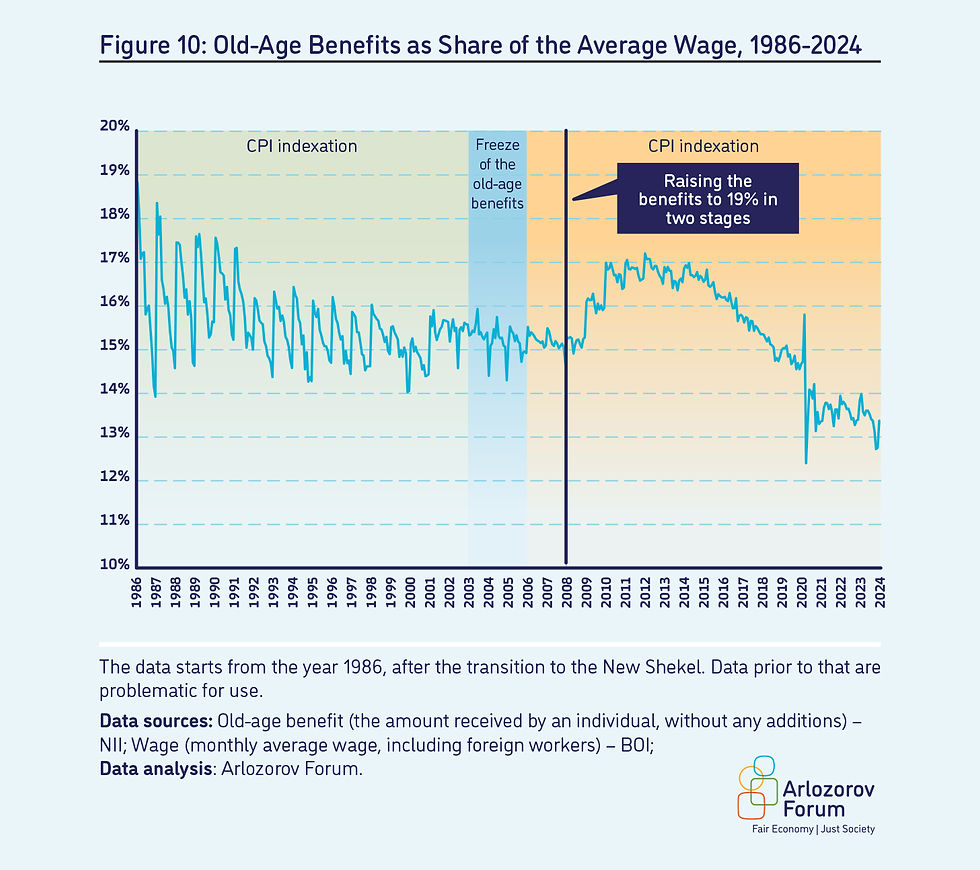
As explained in the previous chapter, when large changes occur in a short period, the benefit may erode temporarily between updates relative to the index to which it is indexed. In Israel, at the beginning of each year, the old-age benefit is updated and increased by the same percentage by which the CPI has increased. During the year, until the next update, large changes in the market can occur, and since the benefit is paid monthly and the update is annual, the benefit will erode month by month until the next update. Therefore, in principle, it can be argued that the erosion during the year, which disappears with the update, represents a loss in the benefit's value, as it diverges from the index each month. However, as shown by the data presented in Figure 10, since 2012, the erosion relative to the average wage (which is greater than the erosion relative to the CPI) between updates has not exceeded 0.5% of the average wage (except in 2020, when a significant and temporary change in the average wage occurred due to COVID-19). Nonetheless, it is important to note that this phenomenon is true during periods of stability in the index to which the benefit is indexed, while during less stable periods, such as the 1980s, when there was high inflation, the erosion between updates was higher and reached up to 5 percentage points.
Figure 11 shows the development of different indices from 1986 to 2024. The erosion of the old-age benefit can also be seen in this figure, during the freeze period (2003–2006), when the benefit (green line in the figure) begins to erode relative to the average wage (orange line).[22] Additionally, from 2012 to 2021, inflation was low, meaning the CPI (yellow line) remained relatively stable during these years, but the average wage continued to rise, causing the old-age benefit to erode relative to the wage. Since 2021, there has been an increase in prices, but wages have still risen at a faster pace. Overall, from 1986 to today (2024), the benefit has increased tenfold, while wages have risen twelvefold. In other words, the benefit indexed to the CPI has eroded relative to wages, and its purchasing power relative to the rest of the population has decreased. Even looking at recent years, we see that there has been erosion relative to wages. Since 2012 (until 2024), wages have increased by 48%, while the old-age benefit has only risen by 17%. Additionally, as seen in the figure, the CPI has increased at a notably slower rate. It is likely that this long-term trend will not change in the foreseeable future (Bank of Israel, 2024). Therefore, if we continue to index the benefit to the CPI, it may continue to diverge from the average wage, and as time goes on, the gap will grow, as we see with the CPI relative to wages.

What the Value of the Old-Age Benefits in Israel Could Have Been with Different Indexations
Figure 12 presents the actual old-age benefit alongside three hypothetical scenarios, illustrating what the benefit would have looked like if it had been indexed, starting in 1986, to different indices. Since creating a forecast for the various indexations goes beyond the scope of this paper, we chose to present different scenarios based on the historical development of the benefit, as well as the cost estimates we make in Chapter 5.
As of 2024, the benefit stands at 1,736 ILS, which is about 13% of the average wage. In the first scenario, the benefit is indexed to the average wage from 1986 to the present (2024). This indexation increases the benefit by the highest rate, bringing the benefit to 2,445 ILS, which is about 19% of the wage, or 700 ILS more than the current benefit. In the second scenario, the benefit is indexed to the CPI. This is the most fiscally conservative of the indexations, bringing the benefit to 1,345 ILS, which is about 10% of the average wage. In the third scenario, the benefit is indexed to a combined index, giving 50% weight to the average wage and 50% to the CPI. This indexation results in an intermediate amount of 1,895 ILS, about 15% of the average wage.

5. The Budgetary Implications of Different Reforms to the Old-Age Benefit
The financial crisis facing the NII has been known for over a decade (Koreh, 2019). Old-age benefits, which are part of National Insurance expenditures, are a component of this broader issue. In the following paragraphs, we will present a budgetary analysis of the expenditure side, that is, an analysis aimed at estimating the expenditure gap required by a change in the indexation method. It is possible that maintaining the insurance nature of the benefit, as suggested by Koreh (2019), and increasing employer and/or employee contributions to National Insurance, could help increase public trust in funding the benefit's growth. However, this analysis is done without addressing the issue of funding, which goes beyond the scope of this paper.
Although this paper does not delve deeply into the funding issue, it is important to note that it is clear that the NII's budget must grow to resolve the actuarial issues of the Institute (likely through raising employer contributions, which are relatively low in Israel compared to international standards) (OECD, 2024). However, since this paper does not compare the importance of different benefits, we do not address the issue of the "division of the pie," but rather point to the state of the old-age benefit, its implications, and the actions that could change its state and their costs.
Budgetary Estimate for a One-Time Increase in the Benefit Level
According to data from the Bank of Israel (BOI), the Israeli average wage in 2023 was 12,149 ILS. Figure 13 presents an estimate of the costs for 2023 if the benefit were increased to a certain percentage of the average wage. If the government were to increase the benefit to 15% of the average wage, the benefit would amount to 1,822 ILS per month; an increase to 20% of the average wage would raise the benefit to 2,430 ILS per month; and an increase to 25% of the wage (as initially set in 1954) would raise the benefit to 3,037 ILS per month. The figure shows that the additional annual costs for these scenarios, considering the number of benefit recipients and a rough estimate of additions based on seniority,[23] would be approximately 3, 15, and 27 billion ILS in 2023, respectively.

Budgetary Estimate for a Permanent Change in the Indexation Method and Update Frequency
Another analysis we conducted examines the costs for different hypothetical indexation scenarios. Figures 14 and 15 present an estimate we performed based on data from the NII and the BOI. In this estimate, we examined the costs for the hypothetical indexations shown in Figure 12 (indexation to the average wage, indexation to the CPI, and combined indexation of 50% to the average wage and 50% to the CPI), with two different update frequencies (monthly and annual), starting from 1986 (as in Figure 12). In Figure 14, we present a rough estimate[24] of the annual cost for each scenario. In 2023, the cost of old-age benefits was about 33 billion ILS (right column).[25] Had the benefit been indexed to the average wage with an annual update, an additional 12 billion ILS would have been required in 2023. In contrast, indexing to the CPI would have reduced the cost of the benefits by about 7.3 to 9 billion ILS compared to the actual cost.

In Figure 15, it is shown that for an individual receiving only the basic benefit, the transition from the current (2024) benefit level to a benefit indexed to the average wage from 1986 to the present (2024), updated annually, results in an increase of over 7,000 ILS annually. This is a very significant amount, especially for low-income earners. Appendix 2 presents the table with the full data from which the figure was created.

In Chapter 3, we discussed the frequency of updates and noted that there is no substantial difference between a very high update frequency (monthly updates) and the frequency commonly applied in Israel today (annual updates). In Figure 15, it can be seen that the difference in the amounts received by the beneficiaries due to the update frequency (for example, in the case of combined indexation, the difference between monthly and annual update frequency is 138 ILS per year) is small compared to the changes in amounts resulting from the type of indexation method (for example, with annual updates, the difference between combined indexation and average wage indexation is 5,860 ILS per year). In the extreme case, the difference in update frequency is estimated at less than 1,000 ILS in 2023 for the case of average wage indexation. This amount is relatively small compared to the differences seen in the figure between the different indexations, but it can be significant for low-income households. It is important to note that these differences are expected to grow in years with large fluctuations in the indices.
Summary
The standard of living for elderly citizens in Israel is low compared to the rest of the world, and they are unable to maintain a standard of living similar to what they had during their working years. Additionally, many of them have no pension income other than the old-age benefit, which results in very low income relative to the average wage and the poverty line. Furthermore, many continue working even in old age, with one possible reason being the low standard of living, which does not allow them to stop working.
Since 2006, old-age benefits in Israel have been indexed to the CPI, an indexation that significantly erodes the purchasing power of the benefits compared to indexing to the average wage, thus also compared to the working population. This indexation harms, and could continue to harm, the elderly population in general, and particularly the vulnerable elderly population, mainly due to the fact that many retirees have no workplace pension, so the old-age benefit constitutes a significant income for them. While there is a global trend toward this type of indexation (CPI), we have shown that the arguments used worldwide are less relevant to Israel, as Israel's growth is higher than that of developed countries, and its population is aging more slowly.
To maintain a decent standard of living for individuals after retirement, it is possible to update the old-age benefit by indexing it to different indices. The indexation that would most significantly improve the benefit amount is indexing to the average wage. This would allow the elderly population to benefit from the economic growth of the country, ensuring that their standard of living does not lag behind the working population, whose real wages increase. The main disadvantage of this indexation is that it is the most expensive for the state. In our simulation, we saw that if the benefit had been indexed to the average wage from 1986 to today (2024), it would have been more than 7,000 ILS higher per year in 2023. The budgetary cost of this increase is about 12 billion ILS, which is about 0.6% of annual GDP. Furthermore, we showed that raising the benefit to 15%, 20%, and 25% of the average wage would increase the cost by 3, 15, and 27 billion ILS, which are approximately 0.16%, 0.8%, and 1.4% of annual GDP, respectively.
Although this paper does not discuss the funding methods for increasing the old-age benefit, we highlighted the need for increased funding for the NII in general, and particularly, in relation to raising the old-age benefit, and pointed out several potential sources for increasing funding, such as raising National Insurance contributions. It is important to emphasize that the NII’s budget funds many important benefits, and this paper does not compare the various benefits and their importance.
As shown throughout this paper, the old-age benefit is currently very low relative to the average wage and continues to erode in relation to it over time. This erosion harms the elderly population, which is a particularly vulnerable group, and it is the state’s responsibility to protect them and future generations.
Please find the appendices and references in the full research paper:
[1] The old-age benefit is guaranteed to every resident, with two exceptions:
If, during their years of residence, the resident did not pay social insurance contributions as required by law.
If the resident immigrated to Israel at retirement age, meaning they never paid social insurance contributions.
(National Insurance Institute website). Therefore, nearly all residents of the country who are of retirement age are entitled to the old-age benefit.
[2] The funding of the NII (National Insurance Institute) comes in part from compensation by the MOF (Ministry of Finance), which began with the reduction in employer contribution rates in the 1990s. Two-thirds of the old-age benefit is funded by the contributions of the employer and employee, as well as the interest on these contributions, while one-third is funded by the MOF compensation. (NII, 2022)
[3] For more details on the funding of the National Insurance Institute (NII) and its actuarial status, see: Koreh, 2019; Koreh, Wolf, and Cohen, 2021.
[4] The replacement rate is measured upon retirement and based on the last salary before retirement.
[5] Total income after retirement divided by the salary before retirement. This data is consistent with the data presented in the CBS study on the replacement rate (Forman, 2024).
[6] The comparison countries are: Austria, Belgium, Denmark, Finland, Netherlands, and Sweden.
[7] Calculated from average wage of 13,091 ILS per-month (OECD, 2023 a).
[8] For a one-person household.
[9] The caveat and the use of the word 'may' stem from the fact that the available data includes information on the replacement rate of workers earning half the average wage, rather than on the replacement rate of those earning below this amount. There is a theoretical, highly unlikely possibility that earners with wages lower than 50% of the average wage have a very high replacement rate, which would bring them above the poverty line, but we are unable to demonstrate this with certainty.
[10] There are additional indicators that allow for comparisons between countries, such as PPP (Purchasing Power Parity), but this indicator only compares prices. To assess purchasing power, it is necessary to combine the price level with the wage level, or to compare the benefits level to the average wage level.
[11] According to OECD data and our calculation, which is based on data from the National Insurance Institute and the Bank of Israel (10.2% and 13%, respectively). We chose to include the OECD number because it allows for international comparison. Additionally, 13% is also a low number, which does not change Israel's position relative to OECD countries.
[12] Out of the 6 comparison countries (Austria, Belgium, Denmark, Finland, Netherlands, and Sweden), only Denmark and the Netherlands apply a universal old-age benefits policy.
[13] 58% of retirees do not receive a pension, Labor and Welfare Committee, Knesset website, 1.3.22. (Hebrew)
[14] According to PUF data from the CBS: Central Bureau of Statistics’ survey on household expenditure and income.
[15] Appendix 1 provides the full details on the indexations in the different countries.
[16] The consumption basket of the elderly population varies significantly between countries according to the services provided by the state. For example, if a country provides good public healthcare services, the gap between the indices will change, as the elderly population consumes more healthcare services. Therefore, if such an index is used in the future, in order to keep it freer from subjective considerations, the basket could be defined similarly to the Consumer Price Index by weighting the consumption patterns of the elderly community.
[17] The world bank, GDP growth, Israel
[18] The old-age benefits in Israel, unlike the income supplement benefits (funded by the state budget), are primarily funded by National Insurance and the money that citizens contribute to it. The amount contributed is determined by wages (the rate of National Insurance and health insurance contributions for salaried workers residing in Israel, from age 18 until retirement, NII website, 2024, Hebrew). In other words, when wages rise, National Insurance income also rises. However, the increase is made up of different percentages for different income levels, so the increase in National Insurance income depends on the population for whom the wages have risen. Therefore, the income of National Insurance will not necessarily increase at the exact same rate at which the benefit indexed to wages increases. Nevertheless, there seems to be a financial potential for indexation to wages, and the justification for fiscal restraint in the shift to indexation to the price index is questionable.
[19] For example, if the benefit level is 100 ILS per month, and the index to which the benefit is indexed increases by one percent at the beginning of the year and by another percent after six months, with a biennial update, the benefit would be 101 ILS for the first half of the year and 102 ILS for the second half (totaling 1,218 ILS for the year). In contrast, if the update were annual, the benefit would total 1,212 ILS for the year, which is 6 ILS less.
[20] The erosion shown in Figure 10 was predicted in the NII’s report from 2003, which forecasted that the old-age benefit would erode by 2020 and reach about 12% of the average wage (NII, 2003).
[21] For an explanation of the erosion of the old-age benefit relative to the average wage in the 1980s and 1990s, see Appendix 3.
[22] In the figure, there is no exact match between the wage and the benefit during the years when the benefit was indexed to the wage. Part of the reason for this is that the wage series used for the wage indexation is a special wage series of the NII. This series is not updated monthly, and at times, updates are not made for various reasons. The wage in our calculations is based on data from the Bank of Israel, which is based on actual wages and updated continuously every month. These data differ from the NII's wage series and create a gap between the average wage and the old-age benefit, even during the period when the benefit was indexed to the average wage. However, this does not fully explain the gap.
[23] We estimated the seniority addition as a 60% increase, which is the gap we found between our estimate and the actual cost.
[24] In Figure 14, in order to estimate the cost including various additions, such as seniority, we multiplied the number of benefit recipients by the base benefit and increased the cost by 60%. We chose to multiply by 60% because that was the gap we found between our estimated benefit and the total cost published by the NII.
[25] 33 billion ILS is the estimate by the NII for 2023, calculated based on National Insurance data:



תגובות