


The Great Fissure: The Fissured Economy in Israel and the Situation in Other Countries
Dr. Gali Racabi
March 2026
The organizational structure of the workplace is changing. Alongside traditional workplaces, fissured forms of employment are emerging, including triangular employment arrangements, independent contractor or freelancer agreements, franchising, and platform-based work. The academic literature identifies links between the growth in the number of fissured workplaces and a decline in workers’ bargaining power at the workplace, along with an increase in inequality in developed countries. Although internationally, regulatory attention is being paid to these forms of employment, in Israel, direct regulation exists only with respect to contractor-based employment, with the country’s labor court system playing a central role in determining workers’ status in the labor market. The absence of regulation of other forms of fissured employment acts as a catalyst for the expansion of such forms, erosion of workers’ bargaining power, and a rise in inequality. In this paper, we present available data on the growth of the fissured economy in Israel, examine its implications and challenges, and review current regulatory approaches in this field across various countries worldwide.
Executive Summary
The organizational structure of the workplace is changing. Alongside the traditional workplace, fissured forms of employment are emerging, including triangular employment arrangements through staffing agencies or service contractors, independent contractor or freelance work, franchising, and platform-based work. The academic literature identifies links between the growth in the number of fissured workplaces and a decline in workers’ bargaining power, along with an increase in inequality. Although internationally, regulatory attention is being paid to these forms of employment and their monitoring, in Israel, direct regulation primarily applies to contractor-based employment, and labor courts play a central role in determining workers’ general status in the labor market. The absence of regulation of other forms of fissured employment catalyzes their expansion, erodes workers’ bargaining power, and increases inequality.
The Relationship Between Labor Market Structure and Inequality
Inequality in Israel constitutes a social and political problem. The relationship between labor market structure and inequality is well recognized in the literature and public discourse; however, the discussion focuses primarily on issues such as the participation of different populations in the labor market and the level of the minimum wage, whereas developments within workplaces and the role of the state in shaping the world of work remain largely outside public discourse. In recent decades, the literature has indicated changes in the organizational structure of businesses and workplaces, in particular the creation of a significant organizational periphery as a central factor shaping workers’ bargaining power.
Organizational Changes in Workplaces
The literature defines a “fissured workplace” as one in which there is no single source of managerial authority but rather a variety of sources responsible for determining working conditions, wages, hiring criteria, promotion, supervision, and control of work performance, enforcement of safety rules, and more. Authority fragmentation occurs through various combinations of firms, contractors, independent workers, and clients. The relationship between the organizational core and its periphery is mediated through market mechanisms at the expense of the internal labor market. As one moves further from the organizational core, wages, working conditions, job security, and the ability to enforce rights can be expected to decline; consequently, the demography of the organizational periphery is typically composed of disadvantaged populations.
What Is the Problem with Workplace Fissuring?
The literature identifies mechanisms linking workplace organizational structure to a decline in workers’ bargaining power, including exit from the firm’s internal labor market, misalignment between working conditions and protective labor legislation, chronic under-enforcement of labor rights, exposure to new risks not recognized in existing legislation, and exposure to monopsonist labor markets and anticompetitive practices. Israeli literature emphasizes the dependence of labor and welfare legislation on specific organizational forms, as well as the emergence of a dual labor market, reflected in wage disparities, differences in tenure, and limited mobility between groups of workers.
What Is the Scope of Fissured Employment in Israel?
Measuring the scope of fissured employment in Israel is incomplete and complex, as existing measurement methods are tailored to classical employment relationships. Nevertheless, available data indicate an increase in the scope of fissured employment in recent decades. According to estimates based on various data sources and detailed measurement assumptions, in 2023 the number of workers engaged in fissured employment in Israel ranged between approximately 250,000 and 480,000, representing approximately 5.8% to 11.1% of the total workforce. Over the past decade, subcontractor-based employment in Israel has remained relatively stable. In contrast, the number of self-employed individuals and VAT-exempt businesses has increased over time, with some stabilization since 2020. Regarding franchising and platform-based work, there is a significant lack of data.
What Regulation Exists for Fissured Employment in Israel?
In Israel, the primary regulatory aspect of the fissured economy is based on legal definitions of “employee” and “employer.” Case law has produced ad hoc solutions, but legal uncertainty exposes workers to exploitation and allows employers to experiment with organizational forms that shift costs onto workers, consumers, and the state. Targeted regulation of specific employment arrangements reduces certain phenomena while simultaneously creating incentives for the development of new forms of fissured employment.
What Regulation Exists for Fissured Employment in Other Countries?
The comparative survey presents various models of regulation in other countries, including economy-wide regulation, regulation of specific employment arrangements, and sectoral regulation. These examples highlight the existence of different approaches for addressing the fissured economy and the fact that regulatory choices directly affect the level of protection afforded to workers.
Conclusion
This paper demonstrates that the expansion of fissured employment in its various forms is associated with a decline in workers’ bargaining power and a deepening of inequality, and that addressing the fissured economy requires an understanding of the organizational structure of the labor market and the dynamics between regulation, enforcement, and the development of new employment models.
Fissured employment in Israel is a significant phenomenon constituting a strategic challenge for the present and future of the Israeli labor market. We hope that this review will contribute to advancing effective and stable regulation of the Israeli labor market, with the aim of reducing inequality by strengthening workers’ bargaining power within the fissured economy.
Introduction:
The Relationship Between Labor Market Structure and Inequality
Inequality in Israel is a social and political problem. The relationship between the structure of the labor market and inequality is well recognized in both the academic literature and public discourse in Israel; however, discussion of this relationship primarily focuses on questions of participation of different populations in the labor market (particularly the participation of ultra-Orthodox Jews and Arabs), and, at most, on the rate of the minimum wage. What occurs within workplaces and the labor market itself, and the question of the state’s role in shaping the world of work, remain largely absent from public view.
In recent decades, both academic and popular writing worldwide have pointed to the need to recognize workplace changes to explain the rise in inequality in developed countries. Scholars from diverse perspectives highlight changes in the organizational structure of businesses and workplaces and, in particular, the creation of a significant organizational periphery as a central factor shaping workers’ bargaining power within the workplace (e.g., Weil, 2014; Stansbury and Summers, 2020). The growing use in the business world of organizational structures based on indirect employment, reduced direct employment, and similar arrangements leads to a decline in workers’ bargaining power, a reduction in employees’ share of product, and an increase in inequality between organizationally-central and peripheral workers.

Academic literature links two well-known phenomena: the rise in inequality in developed countries and the organizational dimension of the disintegration of the traditional workplace. The breakdown of traditional employment forms has additional implications, such as the emergence of a class of precarious workers, a decline in full-time employment rates, and an increase in temporary jobs. These phenomena have complex relationships with the development of workplace organizational forms, which are not addressed in this paper.
Organizational Changes in Workplaces
In recent decades, the classic organizational structure of workplaces has undergone fundamental changes. In the traditional workplace, there was a clear managerial hierarchy and direct employment relationships between all workers in a firm and a single employer (Luria [2013] refers to this workplace as a “Fordist” workplace). Today, alongside the classical form of employment, there are employment arrangements in which the workplace is divided between an organizational core and an organizational periphery. Classic examples include the employment of cleaning and security workers, now largely carried out through subcontracting; franchising, which operates through independent contractors or freelancers; and, more recently, the entry of digital platforms into the labor market.
This set of organizational arrangements is referred to in the literature as the “fissured workplace” (Weil, 2014), meaning, a workplace in which there is no single agreed-upon source of managerial authority at the top of the organizational hierarchy but rather a variety of sources of authority responsible, among other things, for determining working conditions, hiring criteria, wage conditions, decisions regarding promotion or bonuses, supervision of work quality, control over how work is performed, and the establishment and enforcement of safety rules. The fragmentation of authority occurs across new combinations of firms, organizations, independent contractors, and clients.
In fissured workplaces, various forms of engagement exist between the organizational core and periphery. Engagement with contractors and service providers in the periphery is carried out through market mechanisms (such as contracting with freelancers, digital platforms, and more) at the expense of the internal labor market, which is considered more stable and beneficial. Because most populations exposed to the external segments of the labor market are those with fewer skills and less capital (such as young people, women, older individuals, and members of disadvantaged groups), the fissured workplace is structured around—and reproduces—relationships between a core and an employment periphery.
Consider, for example, a high-tech company in Israel. The organizational core consists of managers, engineers, and development personnel, most of whom in established firms are directly employed through standard employer-employee relationships. Surrounding the firm is an organizational periphery of independent contractors, freelancers, subcontracting firms, and staffing agencies that provide services to the company (such as cleaning, security, and deliveries) along with firms and contractors (some operating via digital platforms such as Fiverr) that perform core functions (such as software or component development). In the case of a retail company, one may also find franchisees, who in turn may employ their own workers. As one moves further from the organizational core, wage levels, working conditions, job security, and the ability to enforce labor rights tend to decline. Similarly, the composition of the workforce in the employment periphery tends to shift, with the periphery typically consisting of disadvantaged populations with limited capital and bargaining power, offering relatively low-cost labor.
The entry of digital platform companies such as Uber (not in Israel) or Wolt into passenger transportation and delivery markets marks the current peak of workplace fissuring. Uber’s entry into the labor market, connecting millions of drivers with hundreds of millions of passengers worldwide via an application, signifies not only a dramatic change in passenger transportation and related sectors but also a possible direction for the development of platform-based workplaces. For many drivers, Uber is their primary source of income; however, Uber defines its relationship with drivers as not an employer-employee relationship. According to estimates by the European Commission, in 2021 approximately 28 million platform workers in Europe were employed by roughly 500 platform companies. In the United States, about 16% of adults have engaged in platform work, and for about one-third of them, it constituted a primary source of income (European Council, 2022).
A. What is the Problem with Workplace Fissuring?
Organizational Expressions of Fissured Workplaces
The fissuring of the traditional workplace has three established organizational expressions, and platform work has created a fourth:
Triangular employment/subcontracted employment – In this set of arrangements, the company enters into service contracts with firms specializing in providing labor (service contractors) or workers (staffing agencies). For example, a software company contracts with a service contractor to provide cleaning services or with a staffing agency to find a temporary administrative assistant.
Independent contractor or freelancer arrangements – In this form, a company contracts with individuals to perform a defined task. Traditionally, this arrangement was common in specific sectors (e.g., freelance journalism) or in occupations requiring particular expertise or specialization (e.g., technicians, plumbers). Some independent contractors derive most of their income from a single client, whereas others rely on multiple clients.
Franchising – In this set of arrangements, a company (the franchisor) contracts with entrepreneurs (franchisees) for the use of trademarks, business methods (such as sales software, recipes, store design), and the purchase of products in exchange for payment. For example, a McDonald’s franchisee contracts with McDonald’s to open three branches in the northern region of Israel. Typically, the franchisee is responsible for hiring workers. Still, there is considerable variation among franchisors in the degree of control over working conditions, ranging from highly centralized, significant control to minimal control.
Platform companies – In this arrangement, a platform company (e.g., Uber) operates an app or website that connects clients and workers to perform a task in exchange for payment derived from the transaction. Different platforms exercise varying degrees of control over interactions between clients and workers and over working conditions on their platforms.
Across these various organizational expressions of fissured employment, the formal direct relationship between worker and employer is either completely severed or rendered ambiguous. The workplace is divided into an employment core and an employment periphery, and the costs and risks associated with employment are externalized to specialized firms, independent contractors, clients, or to the state and its institutions (for example, through the provision of welfare services).

The Relationship Between Organizational Structure and Workers’ Bargaining Power
Professional literature identifies numerous mechanisms linking the organizational structure of employment to the decline in workers’ bargaining power in fissured workplaces:
Workers outside the firm’s internal labor market are therefore more exposed than internal workers to wage reductions, deteriorating working conditions, and the risk of job loss (Weil, 2014).
Workers experience a fundamental mismatch between the nature of their work and working conditions and those protected by labor legislation. For example, legislation based on tenure accumulation or on worker organization relies on a relatively stable, continuous workplace. It is not adapted to fissured workplaces, despite the clear legal ability to organize workers in such settings (Luria, 2013).
Workers suffer from chronic under-enforcement of labor rights (Weil, 2014).
Workers are exposed to new or unrecognized risks that are not addressed by standard welfare legislation. For example, platform workers are subject to new forms of monitoring and control not recognized in Israeli legislation (see, for example, European Council, 2022).
Workers are more exposed to monopsonistic labor markets and anticompetitive practices (Krueger and Ashenfelter, 2018).
Even where labor organizations exist, their ability to identify and use sources of bargaining power (such as strikes) is more limited than in traditional workplaces. This disadvantage may stem from legal sources (such as competition law restricting coordination and strikes among independent contractors) (Racabi, 2020) or organizational factors (such as high turnover within bargaining units) (Weil, 2014).
The Israeli literature presents two central insights regarding the negative implications of fissured workplaces for workers. One crucial insight, identified by Luria (2013), is the dependence of labor and welfare legislation in Israel on specific organizational forms. According to Luria, labor and welfare legislation is based on tenure and continuity within a particular workplace. As more workplaces, sectors, and occupations shift from structures offering long internal career paths to those relying on temporary and part-time work, the impact of welfare legislation in Israel has changed.
This phenomenon—whereby the impact of policy changes as the circumstances in which it operates change (Hacker et al., 2015)—is referred to in the academic literature as “policy drift.” According to Luria, the effect of welfare legislation has shifted as the organizational context in which it operates has changed. In a system in which protective legislation is built around long-term, full-time employment in a single workplace, as more workers are employed in temporary and part-time jobs, the number of protected workers and the quality of protection provided by such legislation both decline (Margalit, 2020). Another example of policy drift is the mismatch between the legal framework governing labor organizations and the changing workplace. For example, in workplaces where workers employed by different companies work side by side, and sometimes alongside individuals not classified as employees at all, it is extremely difficult to establish worker organizations, build solidarity, or carry out collective actions. In addition to the fundamental mismatch between existing labor and welfare legislation and new organizational structures in the labor market, comparative literature also identifies a significant lack of information available to administrative authorities regarding these workplaces, along with a substantial impairment in the state’s ability to enforce labor laws within these workplaces (Weil, 2014).
A second core insight concerns the direct impact of labor-market organizational structure changes on different groups of workers. For example, Margalit (2020) identified the emergence of a “dual” labor market in Israel. According to Margalit, the Israeli labor market is divided into two segments based on differences in education, union coverage, and workplace type (direct versus indirect employment). This duality is reflected in wage gaps, tenure differences, and limited mobility between the two segments of the labor market. Comparative literature reinforces this insight through the negative relationship between non-standard forms of employment and levels of worker organization and coverage (i.e., as non-standard employment increases, organization and coverage decline), along with the negative consequences of moving workers from the firm’s “internal” labor market to “external” labor markets in terms of wages and job security (Weil, 2014).
Other studies on the world of work link the decline in workers’ bargaining power and workplace organizational changes to a lack of competition and the monopolization of labor markets (the creation of monopsonies by large firms that control employment conditions across substantial portions of local labor markets). For example, a study of franchise networks found that most large networks in the United States use no-poaching clauses as a standard part of franchise agreements (Krueger and Ashenfelter, 2018). For instance, McDonald’s includes in its standard franchise agreement a prohibition on franchisees—legally separate entities—from hiring workers who are seeking to leave other McDonald’s franchisees. In this way, the network prevents competition over wages and working conditions among its franchisees. These aggressive contractual clauses coexist alongside mechanisms for coordinating wages and working conditions, which are standard parts of franchise network operations (Krueger and Ashenfelter, 2018). Similar competitive risks have been identified in research on other new forms of employment (e.g., platform companies) (see, for example, Hylton, 2019).

The impact of organizational structure on workers’ rights (Luria, 2013) and the broader implications of the use of new organizational structures for the labor market as a whole (Margalit, 2020) necessitate mapping the current situation, discussing the risks and challenges franchising generates, and providing an appropriate regulatory response.
B. What Is the Scope of Fissured Employment in Israel?
Measuring the scope of the fissured work phenomenon, in Israel and globally, has been incomplete and complex. Even the monitoring of relatively long-standing aspects of the fissured economy, such as contractor-based employment and the employment of self-employed individuals and freelancers, is inconsistent. This constitutes a severe lack of essential information for regulatory agencies. The methods used to measure the labor market and labor market regulation are adapted to classical employment relationships that were prevalent in the economy in the 1950s. If one seeks to measure the extent of fissured employment relationships or the degree of partial employment in the economy (which often overlap), existing measurement and reporting methods are not suitable (Hominar Rosenblum, 2022; Katz and Krueger, 2019).
Despite these challenges, this chapter presents the existing findings regarding the scope of fissured employment in Israel. Notwithstanding the significant lack of high-quality data, a trend of increasing fissured employment in Israel can be identified.
Contractor-Based Employment in Israel
Data on contractor-based employment in Israel are not uniform, and the difficulty of estimating them has been recognized for many years. In 2007, approximately 20% of all public sector employees were employed through contractor-based arrangements. In 2009, the share of workers in contractor-based employment stood at approximately 4.3% of all workers in the economy (Pensirer, 2011).
Two primary sources of information collect data on contractor-based employment—the Social Survey and the Labor Force Survey—both conducted by the Central Bureau of Statistics (CBS). Based on these data, we present below two rough estimates of the number of individuals employed in contractor-based roles in Israel (service contractor employees and staffing and agency workers), which differ.
Figure 4 presents data from the CBS Social Survey, indicating that the long-term trend is relatively stable. According to the data, in 2024, 106,000 individuals were employed in contractor-based arrangements out of approximately 3.5 million wage earners. As noted, since 2008 the trend has been relatively stable, with an average rate of approximately 3.6% of total employees (approximately 3% of the total workforce), despite recent disruptions caused by the COVID-19 pandemic and the “Iron Swords” war.
Figure 4: Number of employees in staffing companies in Israel and their share of total employees, according to CBS Social Survey data, 2003, 2008–2024.

Data source: CBS Social Survey, various years; data processing: Arlozorov Forum.
Figure 5 presents processed data from the Labor Force Survey (see details in the appendix).
According to these data, we estimate that approximately 223,000 individuals were employed in contractor-based arrangements in 2023. In 2008, the share of contractor-based employment among all employed persons was 6.3%. Over time, this share declined somewhat and stabilized at approximately 5%.
Figure 5: Estimated number of individuals employed in contractor-based employment in Israel and their share of total employment, according to CBS Labor Force Survey data, 2003, 2008–2023.

Until 2011, classification was based on the 1993 industrial classification, and the adjustment we made between classifications is not perfect; however, the mismatch tends to underestimate the phenomenon. From 2009 onward, the data are based on the 2008 census, and earlier data are chained according to the 2009 ratio. From 2012 onward, the data refer to the entire labor force (including security services).
Data source: CBS Labor Force Survey, various years; data processing: Arlozorov Forum
Two points stand out when the two figures are compared. First, there is a significant gap between the surveys in the total number of workers employed in contractor-based arrangements. According to the Labor Force Survey, 223,000 individuals were employed in such arrangements in 2023, whereas the Social Survey reports approximately 137,000 employees in that same year. It is unlikely that this gap results from the fact that the Social Survey reports employees, whereas the Labor Force Survey reports all employed persons, as this would imply a difference of approximately 86,000 self-employed individuals in contractor-based employment. Therefore, we presume that the discrepancy also reflects substantive differences in the estimation methods between the surveys. The second notable point is that contractor-based employment has been a relatively stable phenomenon in Israel over the past decade, with a share ranging from 3% to 5.4% of total employment.
Self-Employed Individuals and Freelancers in Israel
Self-employed individuals who do not employ others constitute a common definition for estimating the scope of self-employment and freelancing in Israel (Hominar Rosenblum, 2022). A primary source of information for classifying self-employed individuals is the tax authorities’ records. Accordingly, based on the “Business Register” database, in 2023, the CBS reported 475,709 self-employed businesses, of which approximately 333,514 were self-employed individuals who do not employ others.
The first limitation of relying exclusively on Business Register data is that this population excludes individuals exempt from value-added tax (VAT). The population of VAT-exempt individuals may be significant for identifying independent contractors affected by labor-market changes, as this category includes individuals with relatively low incomes who qualify for VAT exemption. As shown in Figure 6, the number of VAT-exempt individuals and their share among all businesses and all employed persons increased steadily until 2020 and has remained stable since. In 2015, there were 129,000 VAT-exempt individuals, constituting 20% of all businesses and 3.5% of all employed persons. This number peaked at 197,000 in 2020, representing approximately 25% of all businesses and approximately 5% of all employed persons. It declined in 2023 to approximately 189,000, representing 22% of all businesses and approximately 4.4% of all employed persons. Overall, this reflects a relatively high average annual growth rate of approximately 5.2% during this period.
Figure 6: Number of VAT-exempt individuals in Israel and their share of all businesses, according to VAT data, 2011–2023

From 2012 onward, the data refer to the entire labor force (including security services). In 2015, the number of VAT-exempt individuals increased compared with previous years due to enforcement measures targeting previously unreported VAT-exempt individuals. Data source: Businesses and turnover by industry according to VAT, CBS, various years; data processing: Arlozorov Forum.
Another issue arises when comparing Business Register data with CBS survey data from the Labor Force Survey and the Social Survey. In the Labor Force Survey, an individual is defined as self-employed if they work in their own business and do not employ others. Figure 7 presents the number of self-employed individuals and their share of total employment based on Labor Force Survey data compared with Business Register data. In the first case, the data represent individuals working in their own business without paid employees (in yellow). In contrast, in the second case, they represent self-employed individuals and companies that do not employ workers (in red).
Figure 7: Number of self-employed individuals and their share of total employment, according to CBS Labor Force Survey data and Business Register data, 2003, 2008–2023

Until 2011, classification was based on the 1993 industrial classification, and the adjustment we made between classifications is not perfect; however, the mismatch tends to underestimate the phenomenon. From 2009 onward, the data are based on the 2008 census, and earlier data are chained according to the 2009 ratio. From 2012 onward, the data refer to the entire labor force (including security services).Data source: Business demography—statistical data compilation from the Business Register, various years; and CBS Labor Force Survey, various years; data processing: Arlozorov Forum.
As can be seen, despite certain gaps over the years between Labor Force Survey and Business Register data, by 2023 the figures were very similar, at approximately 380,000 self-employed individuals. In contrast, Social Survey data (available only up to 2021) indicate that in 2021, 68,643 self-employed individuals did not employ wage earners—a markedly different picture from that derived from the other two data sources. These data gaps constitute an obstacle to understanding the scope of independent contractor employment in Israel.
Nevertheless, as with the trend observed among VAT-exempt individuals, the number of self-employed individuals has increased significantly over recent decades, with some stabilization since 2020. According to the Labor Force Survey, the share of self-employed individuals rose from approximately 7% in 2003 to 7.7% in 2012, continued to rise to approximately 9% in 2020, and remained stable through 2023. According to the Business Register, the share of self-employed individuals among all employed persons shows a mixed trend over the period: approximately 8% in 2003, 7.7% in 2013, and an increase in 2021 followed by stabilization at 8.8% in 2023. Overall, these trends reflect an average annual increase of approximately 3.6% from both sources (compared with approximately 2.3% for total employment).
Workers in Franchise Networks in Israel
Currently, there are no available data regarding franchise-based work in Israel. This constitutes a severe information gap. In comparative literature, the growth of franchising in recent decades is recognized as one of the most significant developments in the business world and, consequently, in the world of work. In the United States, for example, estimates for 2017 indicated that at least approximately 5% of the American workforce—about 9.6 million workers—were employed in franchise networks (Zamora-Appel and Jubran, 2021).
Franchisees operate across a wide range of industries. Figure 8 presents the distribution of franchise networks across sectors, based on a survey of approximately 150 large U.S. franchise networks.
Figure 8: Sectoral distribution of large franchise networks in the United States

Data source: Krueger and Ashenfelter, 2018; data processing: Arlozorov Forum
In Europe, the sectoral distribution of franchisees is even broader. According to industry estimates, the number of workers in franchise networks in wholesale and retail trade stands at 3 million out of 29 million workers, with hundreds of franchise networks in each European country and thousands in Western European countries (Abell, 2016).
In Israel, there are no data at all regarding the sectoral distribution of franchise networks. Various publications on franchising in Israel point to sectors such as fast food, fashion retail, real estate, and language education as bases for franchising activity (USCS, 2018). For comparison, in 2023, the retail trade sector in Israel employed approximately 255,000 individuals, and the food service sector, approximately 139,000. A conservative estimate of 10% of total employment in these sectors in franchise networks yields a minimum of approximately 39,000 workers employed in franchising in Israel.
Platform Workers in Israel
Currently, there is no statistical monitoring of platform workers in Israel. A limited number of digital platforms operate in Israel to provide services in the physical world (notably Wolt and Gett), both with workforce estimates ranging from a few thousand (Netanzon et al., 2020) to approximately 20,000 workers (Amsterdamzki, 2025). In our aggregate estimate, we included approximately 17,000 platform workers based on several journalistic sources (Zarchovitz, 2023; Cohen, 2022; Yefet, 2020).
At the same time, digital platforms also operate in Israel to provide remote services, including general platforms such as Fiverr and Amazon Mechanical Turk, as well as specialized platforms (for example, for remote teaching) where workers perform microtasks or specific projects remotely, sometimes for clients not located in Israel.
Summary
From the foregoing, it is evident there is no high-quality information regarding fissured work in Israel, as existing data sources are partial and based on arbitrary definitions and self-reporting. Despite significant data gaps on two of the most common and expanding forms of fissured employment in Israel (franchise workers and platform workers), it is possible to estimate with a high degree of certainty that, over the past two decades, the fissured economy in Israel has been growing.
Despite the lack of data, we used the available information to produce a rough numerical estimate of the number of workers in fissured employment. This estimate is based on several assumptions. First, various sources are used for estimating contractor-based employment and the self-employed population. We present one estimate based on the Labor Force Survey and a second estimate based on the Social Survey and Business Register data. Second, we included all workers employed by service contractors and staffing companies within the fissured economy. Third, it is likely that many self-employed and VAT-exempt individuals are not part of the fissured economy (such as shop owners); however, in the absence of a clear benchmark, we estimated their number under several scenarios (10%, 25%, and 50% of the number of self-employed and VAT-exempt individuals). Fourth, we included the VAT-exempt population only in the minimum estimate, as the maximum estimate is based on the Labor Force Survey, which already includes this population. Fifth, to estimate the number of workers in franchising, we assumed a 10% rate (based on employment rates in the United States and Europe) of total employment in the food and beverage services (sector 56) and retail trade (sector 47). According to our calculations, as of 2023, the total number of workers in fissured employment in Israel ranges between approximately 250,000 and 480,000, representing approximately 5.8% to 11.1% of the total workforce (Figure 9).

C. What regulation exists regarding fissured employment in Israel?
Over time, changes also occur in methods of fissured employment. Some expand and become more sophisticated, whereas others gradually decline. According to labor force surveys of the Israel Central Bureau of Statistics, the provision of workers through contractor companies and staffing agencies decreased by approximately 70% between 2003 and 2023. According to most explanations in the literature, this decline stems from legislative interventions, regulatory actions, and advocacy by civil society organizations and workers’ organizations. In other words, targeted regulation succeeds in reducing the employment practices to which it applies. At the same time, new employment methods emerge whose purpose is to circumvent existing regulations. In our assessment, indirect and fissured employment arrangements in Israel are on a continual growth trajectory, but they are changing form in response to evolving regulations.
Regulatory tools in the labor market can be classified according to the scope of regulatory action, that is, the group of workers or employers to whom the regulation applies. We propose referring to three levels of organization: The broadest level is the economy-wide level, namely all workers and employers (including self-employed individuals and freelancers); the intermediate level is the fissured employment model (e.g., contractor employment, franchising, platform work, and the like); and the narrowest level is the specific fissured employment model practiced within a particular sector (e.g., delivery services via an application).
At the economy-wide level, the most significant regulatory aspect of the fissured economy consists of two legal building blocks: “Who is an employee for the purposes of labor law?” and “Who is an employer for the purposes of labor law?”
As a result of differing definitions, not all individuals engaged in the economy are entitled to the protections of labor legislation (such as minimum wage, overtime pay, safety, protections against sexual harassment, and more), nor to protections arising from coverage under the National Insurance system (Davidov, 2020). Thus, for example, a Wolt delivery worker engaged as an independent contractor is not entitled to National Insurance coverage or the protections of labor laws. In practice, any individual whom the employer does not define as an employee must rebut the legal presumption in the labor courts to obtain legal protection, in accordance with tests established by the courts.
These tests examine, inter alia, the degree of the worker’s integration into the company—namely, whether their work constitutes an integral part of the company’s regular activity and whether they are incorporated into its organizational structure—along with the degree of control exercised by the employer over working conditions (Hominar Rosenblum, 2022).
Over the years, the labor courts and the Supreme Court have developed and refined tests to determine when an independent contractor will be classified as an employee and when a company purchasing services from independent contractors will be classified as their employer (Davidov, 2016). In addition, the courts have developed doctrines for identifying the employer through rules of “joint employment,” that is, a judicial determination that a lead company serves as a joint employer of a particular worker together with a contractor or manpower agency, for example.
Alongside these developments, existing Israeli law allows courts to recognize workers as covered by specific labor legislation through purposive interpretation of that legislation. This interpretive move is known as the “breach of universality”—recognition of an employment relationship for the purposes of a specific labor statute only. For example, independent contractors or freelancers may be defined as employees under labor laws, including, but not limited to, minimum wage legislation. Recently, in the Super-Pharm case, the National Labor Court established rules regarding when an entity will be recognized as an employer solely for the purposes of the Collective Agreements Law. Two important observations arise here. First, the National Labor Court held that recognizing a franchise network as an employer solely for the purposes of the Collective Agreements Law constitutes an exception that requires special justification. In other words, the breach of universality is not the rule but the exception. Second, the National Labor Court focused the tests for defining the employer on the question of control over employment conditions.
The picture that emerges is that judicial decisions have created effective solutions; however, legislation still provides greater certainty and reduces the need to resort to legal proceedings. Workers are adversely affected because uncertainty exposes them to exploitation. In addition, some employers, particularly small employers, are deterred from demonstrating responsible conduct toward workers, as such conduct may be perceived as creating legal liability toward them. Both consumers and the general public are harmed by the absence of a clearly responsible party for services or for damages caused by businesses operating within the fissured economy. Undoubtedly, the primary beneficiaries of legal uncertainty are employers, as such uncertainty enables them to experiment with new business and organizational forms that shift the costs of employment onto workers, consumers, and the state.
In addition to these foundational building blocks, the state has developed regulatory interventions for certain employment practices and specific sectors. Among the methods associated with the fissured workplace—franchising, self-employment or freelancing, platform work, and contractor employment—the method that has received the greatest regulatory and academic attention is contractor employment (see, for example: Gruber, 2015; Association for Civil Rights in Israel, 2015; Israel Democracy Institute, 2023; Natanzon et al., 2020). Addressing employment through staffing agencies has produced three principal regulatory interventions: regulation and licensing of staffing companies; improvement of enforcement mechanisms for certain laws through the creation of an administrative enforcement channel (focused on wages and other economic conditions); and the creation of an incentive structure for establishing sectoral arrangements between employer associations and workers’ organizations, led by the Histadrut (Natanzon et al., 2020).
A labor market in which extensive regulation applies primarily to a specific employment method pushes both existing and new employers to evade that regulation (Davidov, 2016). Thus, existing law encourages employers to reduce costs and burdens associated with employment by defining work as being performed by independent contractors or by distancing control—that is, by creating an employment structure in which the formal employer reduces its direct supervision over workers, for example, through layers of subcontractors or franchisees. In this way, workers appear to be subordinate to the contractor rather than to the actual company, thereby also reducing their level of “integration” within the organization. The various employment methods characteristic of the fissured world of work are the products of these pressures.
Because employers exercise complete control over the business's organizational structure, and because a market exists for “regulation-evading” employment methods, any regulation of a specific employment method is likely to lead to the emergence of alternative methods. Regulation of direct employment relationships leads to contractor employment and platform companies; regulation of staffing agencies leads to the creation of service-provision companies and the growth of franchising; regulation of the conventional labor market leads to the expansion of independent contracting and the development of new business and organizational forms not subject to regulation (franchising, platform work); and so on. Judicial decisions, such as in the Super-Pharm case, are expected to produce the same dynamic: franchising networks avoiding the explicit conditions identified by the court for defining a franchising network as an employer for the purposes of the Collective Agreements Law. In other words, the court's definition leaves a relatively broad opening for the continuation of harmful employment practices. One of the central concerns in the world of work is that work mediated through digital platforms will become the dominant form of employment; however, there is no guarantee that this constitutes the final stage of organizational development.
The challenge for any policy regulating employment relations is to effectively address this dynamic, in which one of the costs of regulating a specific employment method is the creation of a new, unregulated method.
Case Study: Ten Bis
Written by Adv. Yaakov Avid, the Professional Union for Children, Youth and Young Adults, HaNoar HaOved VeHaLomed
On September 9, 2024, a special collective agreement (Special Collective Agreement No. 20240305) was signed between “Ten Bis” (Scoober Tel Aviv Ltd.) and the National Labor Federation in Israel. The agreement was defined by the parties as a “first and groundbreaking special collective agreement,” as it included the possibility of engaging couriers as independent contractors rather than as salaried employees, unlike Ten Bis workers, who had been employed before the signing of the agreement.
Ostensibly, the collective agreement was intended to allow couriers to choose their employment form (Section 76). Those who wished could continue working as salaried employees, as they had prior to the agreement, with structured shifts, a base salary alongside supplements, incentives, pension contributions, and holiday gifts. Alternatively, those who wished could work as independent contractors, freelancers, or self-employed individuals—without social benefits, but also without any commitment to a specific volume of service or fixed working hours.
Prima facie, the agreement granted couriers the right to choose their mode of engagement with Ten Bis, and even the right to change that choice, subject to a cooling-off period. In practice, however, the agreement permits Ten Bis to reject the applicant’s preference “in accordance with business needs” (Section 20).
Indeed, in July 2025, Ten Bis couriers received an email titled “Important Update – Transition to a New Courier Model in Israel,” informing them of a transition of delivery operations to a model of “independent contractors,” in accordance with the collective agreement and “in cooperation with the workers’ representation.” Couriers who refused to transition were to be offered termination of employment “under conditions that will be provided to you and agreed upon with the workers’ representation,” and those who refused consensual termination would undergo a hearing in accordance with the law.
At first sight, the collective agreement of Ten Bis employees appeared to address platform-based employment through collective tools. The agreement ostensibly allowed workers the flexibility to choose between salaried employment under conditions guaranteed by a collective agreement and independent contractor status, with greater freedom to determine their shifts. In practice, however, the collective agreement enabled Ten Bis management to transfer its couriers—who had previously organized under “HaPoel HaMizrachi” and the Histadrut to improve their conditions—from the status of salaried employees, with social benefits and job security, to the status of “independent contractors,” lacking social benefits, job security, and certainty. This occurred under the auspices of a workers’ organization and a collective agreement, under which even the “independent contractors” pay “handling fees” of 45 NIS per month to the National Labor Federation (Chapter 13.2, Sections 100–104 of the agreement).
D. What regulation exists regarding fissured employment in other countries?
Israel is not unique in the dynamics of a fissured economy, partial regulation, and inequality. Among the many comparative examples of regulatory responses to a fissured labor market, we have chosen to present a limited number of models that may serve as reference points for discussion. These examples are not intended to exhaust the wide range of regulatory experiences worldwide with fissured work but rather to present prototypes of different regulatory models, varying in scope and form.
Economy-wide level: California, USA
At the most general level of regulation—the economy-wide level—the legal rules concerning the definition of “employee” and “employer” have a significant impact. Among existing examples, we have chosen to present that of California, USA.Until recently, as in the current situation in Israel, the definition of who qualifies as an employee for the purposes of state labor law in California was determined through judicial interpretation of terms appearing in legislation. Over the years, various tests and sub-tests developed, revolving around the degree of employer control over workers’ conditions of work. After Uber began operating in California, labor organizations and other progressive groups began advancing litigation concerning the legal status of drivers, alongside broader legislative changes at the state level.These regulatory efforts culminated in 2020 with the enactment of state legislation known as AB5 (Dubal, 2022). This law implemented two central changes at the economy-wide level in California:
It shifted the burden of proof to the employer to demonstrate that a worker is not entitled to legal protections under labor law.
It established three cumulative criteria that must be satisfied to demonstrate that a worker is not entitled to the protections of state labor law:
a. The employer does not control the worker’s performance of the work;
b. The worker performs work that is outside the usual course of the hiring entity’s business; and
c. The worker is customarily engaged in an independently established trade, occupation, or business of the same nature as the work performed.
This legislation in California is similar to the legal frameworks in several other U.S. states that have adopted the same test (also known as the ABC test) for defining who is an employee for labor law purposes (Dubal, 2022). In California, an additional feature was introduced: the possibility of enforcing the law through state attorneys general, independent of individual worker claims. These three layers—direct regulation of the employer–employee definition, shifting the burden of proof to the employer, and strengthening enforcement mechanisms—constitute an example of economy-wide regulation that provides workers with meaningful tools to deal with the adverse effects of a fissured economy.
Franchising: USA
In general, franchising is a domain with limited dedicated regulation. Franchise networks typically operate under the legal risk of being classified as joint employers of franchisee employees. This legal risk derives from the general legal doctrine defining “joint employer,” which, like the doctrine defining “who is an employee,” is based on tests developed through case law and applied on a case-by-case basis by courts and regulatory authorities (Davidov, 2010). Beyond this, relatively few regulatory interventions in employment relations exist within this sector.A contemporary example of expanding regulation of joint employment in the United States is the attempt to introduce secondary legislation (a Rule) concerning joint employment: a situation in which more than one entity is considered together to be the employer of the same worker and shares responsibility toward that worker. This rule defines who qualifies as a joint employer for all purposes, including the obligation to recognize the status or representativeness of a workers’ organization and to engage in collective bargaining, thereby giving rise to a joint employment claim.
There are two notable exceptions in the United States to the general lack of intervention. The first is a requirement in many states for disclosure of information about franchise networks operating within their jurisdictions. For example, many states require franchise networks to submit franchise agreements as part of licensing requirements for operating within the state. In practice, however, these licensing requirements do not affect workers’ rights in franchise networks, and such information disclosure has not proven to be an effective tool.The second exception is sector-specific protective legislation, particularly in the fast-food sector, alongside antitrust law enforcement efforts. In terms of protective legislation, New York City recently enacted protections against unjust dismissal and unilateral schedule changes for fast-food workers (NYC Worker and Consumer Protection, 2023). Additionally, U.S. antitrust authorities at both the federal and state levels have, in recent years, focused on limiting monopsony power (employer monopolies) within franchise networks. For example, enforcement actions have been taken against fast-food outlets that require workers to sign non-compete agreements prohibiting them from transferring to other branches within the same chain.
Self-employed and freelancers: England and Canada
One of the most significant regulatory interventions in fissured employment arrangements involving independent contractors is the creation of a legal status between employees and independent contractors, which entitles individuals to only part of the legal protections afforded to employees. Common examples of such classifications are found in England and Canada. In Canada, a “dependent contractor” is defined as a worker who is economically dependent on a particular entity. For example, an independent contractor whose income is significantly derived from a single client may be classified as dependent on that client for the purposes of this legal definition. This intermediate status entitles the dependent contractor to certain rights under specific labor laws, such as the right to organize. In England, a distinction exists between a “worker” and an “employee.” The latter, whose working conditions reflect a stable engagement under close supervision, is entitled to the full range of labor protections, whereas the former, whose working conditions are more partial and intermittent, is entitled to only some of these protections (Davidov, 2016).Proposals to create a third status between employee and independent contractor have also been raised in the United States, and similar proposals have been discussed in Israel. These proposals aim to bridge the gap between workers fully protected by labor legislation and those without protection due to precarious working conditions. The primary concern regarding such proposals is that creating a new intermediate status may lead to the downgrading of many “full” employees or to misclassification, in which standard employees are reclassified into the new category, thereby depriving them of the full protections provided by labor law.
Platform companies: The European rights vision
The use of digital technologies to manage and organize work is becoming increasingly widespread across the developed world. In response to these changes, in December 2021 the European Commission (the executive arm of the European Union) published a proposal for a directive (EU-level legislation) to improve the working conditions of platform workers. The directive includes a broad set of regulatory proposals across multiple domains related to this form of work (Racabi, 2022; European Council, 2022). The directive, adopted in March 2024, guides EU member states on addressing workers’ rights issues in the platform economy .In addition to the directive, and as part of the same legislative package, the European Commission proposed exempting collective agreements concluded by organizations of self-employed individuals from EU competition law. This exemption means that platform workers classified as independent contractors who organize into workers’ organizations will not be exposed to antitrust liability for forming restrictive agreements.
The directive is a classic example of legislation at the level of the employment model (i.e., all work performed via platforms) and includes two central types of provisions (Aloisi and De Stefano, 2024):
a. Regulation of the process for determining workers’ employment status: The directive establishes that EU member states must adopt, as a default, the presumption that platform workers are employees entitled to the full protections of labor law. While the directive leaves member states to develop the specific legal criteria in accordance with their domestic legal systems, it rules that such criteria should be based on the degree of “control and direction” exercised by the platform over the work.
b. Regulation of workers’ rights in algorithmic management: The directive recognizes the harms associated with algorithmic monitoring and control of workers in the platform economy and includes limitations on the forms of monitoring and the types of data platforms may collect. It also acknowledges the importance of workers’ organizations for effective enforcement of rights and therefore establishes rights of transparency, access, monitoring, and appeal concerning algorithmic management systems for workers and their organizations. It should be noted that, as a regulation applicable across the entire European Union, the directive is also designed for labor relations systems that are not based on firm-level arrangements or on the requirement to formally recognize worker representation through a specific majority within bargaining units.
Platform companies: The libertarian vision in the U.S.
Over the past decade, in response to the growth of the platform economy in the United States, several states have enacted legislation concerning workers' status. This legislation falls into two categories: legislation at the level of the employment model (all work performed via digital platforms) and legislation specific to the paid transportation sector. These laws define different burdens and limitations regarding the classification of workers in the platform economy—or in paid passenger transportation via platforms—as employees rather than independent contractors (Racabi, 2018).
For example, in Florida, a worker on a “marketplace platform” is defined as an independent contractor rather than an employee under state labor law, provided that all of the following criteria are met: (1) the platform does not determine working hours; (2) the platform does not restrict the worker from working on other platforms; (3) the platform does not restrict the worker from working in another business; (4) there is a written agreement stating that the worker is an independent contractor; (5) the worker bears most of the costs of their engagement; and (6) the worker is responsible for paying taxes on income earned from platform work. Other states also include requirements regarding the location of work, but, substantively, this list of criteria is typical. Unlike the European Union directive, these rules are designed in accordance with platform companies' current organizational structures and effectively entrench the classification of platform workers as independent contractors. In contrast to the legislation in California, the default presumption under these frameworks is that platform workers are independent contractors, unless proven otherwise in court or before the relevant regulator (e.g., a state labor department).
In addition to these definitions concerning worker status in the platform economy, other provisions in this legislation address insurance and licensing requirements for both the platform and the worker, prohibitions on the use of alcohol or drugs during work, and prohibitions on discrimination against customers in platform services.This type of legislation, much of which has, in practice, been drafted by platform companies themselves and aligns classification rules with prevailing platform employment structures, represents the libertarian extreme of regulatory approaches to the platform economy worldwide. It effectively secures the classification of workers on digital platforms as independent contractors. Additionally, there are several limited examples of regulatory tools targeting specific sectors, such as legislation governing passenger transportation via platforms in various U.S. states or legislation in Spain aimed at regulating the working conditions of bicycle couriers.
Summary
In Israel and worldwide, various forms of fissured employment are prevalent, including subcontracted employment, employment through franchise networks, self-employed and freelance, and platform-based employment. In this paper, we have demonstrated that the expansion of employment across these various forms of fissured arrangements reduces workers’ bargaining power and increases socioeconomic inequality. We presented the scope of employment through fissured arrangements in Israel and highlighted the significant lack of high-quality data on such employment.
In addition, we showed that internationally there are diverse regulatory approaches to fissured employment. For example, these include universal expansion of the definition of who qualifies as an employee, the allocation of the burden of proof, the granting of new rights, and the extension of labor law's applicability to specific forms of employment. This occurs alongside legislation that preserves the status quo and distances certain workers from labor law protections.
Fissured employment in Israel is a significant phenomenon and poses a strategic challenge for the present and future of the Israeli labor market. We hope this review will contribute to advancing a more stable, improved regulation of the Israeli labor market, with the aim of reducing inequality by strengthening workers’ bargaining power within the fissured economy.
Appendix: Notes on Measuring the Number of Workers in Subcontracted Employment
Three principal methods estimate the scope of fissured employment arrangements: surveys, tax data, and reporting on public-sector employment expenditures. These methods have significant limitations in assessing the scale of the phenomenon. Self-reporting, particularly among workers employed in non-standard arrangements, tends to be incomplete or inaccurate, especially among vulnerable populations such as migrant workers. Measurement based on tax reporting tends to depend on arbitrary legal definitions of tax classifications, which are not contingent on the actual organizational structure and therefore may not accurately reflect it. Reporting on government expenditures in the public sector depends on specific regulatory requirements (such as those governing staffing agency employees) and pertains only to the public sector.
This is the case even though, among the four organizational manifestations of the fissured economy, some form of regular measurement exists only for a portion of workers in subcontracted/triangular employment and for self-employed individuals and freelancers. Regarding franchisees and franchisors, and platform-based work, no dedicated (as opposed to general) data exist in Israel.
Subcontracted Employment
The data depend on the quality of collection, definitions, and measurement methods. At the core of the statistical consensus regarding workers in subcontracted employment are employees of staffing agencies as defined by law and employees of contractors providing security and cleaning services, which are also regulated by law. Surrounding this core group are defined margins of groups explicitly excluded by law from the legislation governing employment through staffing contractors, for example, domestic workers. For these groups, partial data exist, and their inclusion within the definition of subcontracted employment is, as noted, subject to dispute.
Beyond this lies an undefined margin of subcontracted workers, including those employed by service contractors outside the security or cleaning sectors (for example, catering), along with workers in public services who have undergone outsourcing (typically to various nonprofit organizations) (Gruber, 2015; Natanson et al., 2020; Zvi and Carmel, 2017). These margins are undefined due to the absence of data or consensus regarding which sectors are characterized by subcontracted employment. These fundamental disagreements about what should be measured are subject to the politics of labor relations in Israel and to arbitrary decisions regarding which types of work are included in this category. Moreover, even within the core consensus regarding subcontracted workers, the data are not uniform, as evidenced by the comparison presented in the body of the paper between Figures 4 and 5.
Figure 10: Illustration of the Scope of the Subcontracted Employment Category in Israel

Estimating the Scope of Subcontracted Employment from Labor Force Survey Data
In the Central Bureau of Statistics (CBS) Labor Force Survey, respondents are asked whether they received their wages through a staffing agency or contractor. However, as the CBS itself notes, this question does not capture salaried employees working through subcontractors (service contractors). To estimate the number of salaried workers receiving wages from manpower agencies, the CBS aggregates the total number of employees in the sectors of security, support services, cleaning, and domestic services, assuming these are the primary forms of employment in these sectors. This assumption may stem from the legal classification of service contractors under the Manpower Agencies Law as providers of security and cleaning services, or from general knowledge of employment patterns in these sectors.
Accordingly, it is reasonable to treat all salaried employees in these sectors as workers employed through subcontracting arrangements. Based on this assumption, we included all workers in these sectors (Figure 11) and added the total number of respondents who reported being employees of manpower agencies. However, to avoid double-counting, we subtracted the number of workers who reported being employees of staffing agencies and who also belong to sectors identified by the CBS as contractor sectors (Figure 12). The final result is presented in Figure 5.
Figure 11: Number of Workers in Sectors Associated with Service Contractor Employment, Thousands, 2003, 2008–2023
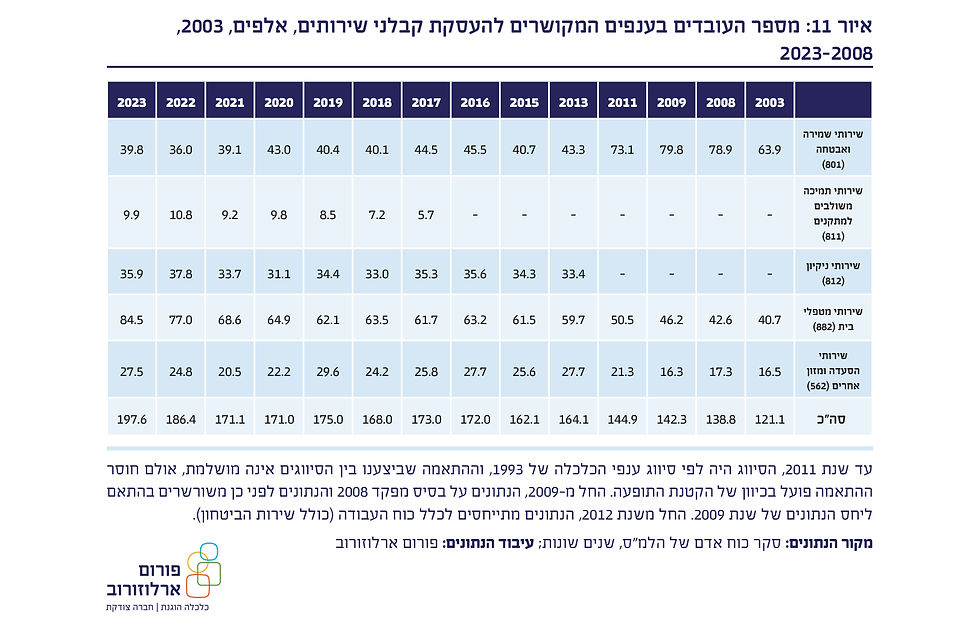
(Notes: Until 2011, classification followed the 1993 industrial classification system; the adjustment between classifications is imperfect but biased toward underestimating the phenomenon. From 2009 onward, data are based on the 2008 census, with earlier data chained accordingly. From 2012 onward, data refer to the entire labor force, including security services. Source: CBS Labor Force Survey; data processing: Arlozorov Forum.)
Figure 12: Number of Salaried Employees Working for Manpower Contractors out of Total Salaried Employees, Thousands, 2003, 2008–2023

(Notes: Same methodological notes as above. Source: CBS Labor Force Survey; data processing: Arlozorov Forum.)
Regarding the employment of workers through staffing and service contractors in the public sector, information is available in various reports of the Commissioner of Wages in the Ministry of Finance, stemming from different regulatory reporting obligations applicable to specific sectors or forms of employment. According to the Commissioner’s reports, in the years 2018 and 2019, approximately 10,000 staffing agency workers were employed by the state and other supported entities. Based on this figure, in 2019 the government was the client of more than half of all staffing contractor workers in Israel.
According to CBS Labor Force Survey data, within government ministries and affiliated agencies, the volume of engagements in the fields of security, protection, cleaning, and catering in that same year stood at approximately 17,800 workers, responsible for providing these services to employees in government offices—approximately 10% of all workers employed in sectors associated with subcontracted employment.


תגובות